
Secure online enrollment
Compare Medicare Plans and Enroll Yourself — You Are Not Alone
Compare Medicare plans and enroll yourself, with a licensed local agent standing behind you at no cost.
When you use the secure enrollment link below, O’Neal Insurance Group automatically becomes your assigned local agent of record. This costs you absolutely nothing.
If you ever have a claim problem, a question about your plan, or need to switch plans next year, you can skip the carrier’s automated phone lines and call us directly.
What you need before you compare Medicare plans
Explore and compare Medicare Advantage and prescription drug plans in your area. Have these ready before you begin so the application does not time out on you.
- Your Medicare card. Have your red, white, and blue card ready for your Part A and Part B start dates.
- Your prescription list. Write down exact drug names, pill dosages, and how often you take them, to check against the Part D formulary.
- Your doctor names. Keep a list of your primary doctors and specialists to confirm your HMO or PPO network fit.
- Your Medicaid number, if you also have state Medicaid.
- A note of the extras you want. Help with food and utilities, fitness membership, flex card, extra dental, vision, or over-the-counter allowances.
Choose how you want to compare Medicare plans
Do it yourself, online
Compare Medicare plans, check your doctors and prescriptions, and enroll securely on your own time.
No wait — help over the phone
Prefer a person? Call and a licensed agent will walk through it with you, or share your screen and do it together.
Mon–Fri, 8am–6pm PST · Mon–Fri, 10am–8pm CST
Protect your information. Do not send Social Security numbers, Medicare numbers, financial information, or medical records by email or through a web form. Use the secure enrollment link or call us directly.
We do not offer every plan available in your area. Currently we represent 30 organizations which offer over 125 products in your area. Please contact Medicare.gov, 1-800-MEDICARE, or your local State Health Insurance Assistance Program (SHIP) to get information on all of your options.
What you are actually comparing when you compare Medicare plans
The quoting tool will show you a monthly premium first, because that is the easiest number to display. It is also the number that predicts your annual cost least well.
When you compare Medicare plans properly you are comparing four separate things at once: whether your doctors are in the network, whether your prescriptions are on the formulary and at what tier, what you would pay across a realistic year rather than a good one, and which extra benefits you would actually use. A plan can win on all four and still not have the lowest premium.
Everything below is what we check on a screen-share, in the order we check it. You can do exactly the same thing yourself with the secure link on this page, and if you would rather not, that is what the phone number is for.
Four checks to run before you compare Medicare plans
Your doctors, by name. Search each physician individually, not the hospital system. A system can be in network while a particular practice inside it is not, and directories go out of date. If a doctor matters to you, confirm it with the practice before the enrollment goes through.
Your prescriptions, with dosages. Enter the exact drug, the exact strength, and how often you take it. Tier placement moves the price far more than the premium does, and the same drug can sit on tier 2 in one plan and tier 4 in another. In 2026 your Part D out-of-pocket spending is capped once you reach $2,100, which changes the arithmetic for anyone on expensive medication.
The total, not the premium. Add twelve months of premium to the deductibles and copays you would realistically incur, then look at the out-of-pocket maximum as your worst case. A zero-premium plan with high copays can cost more across a year than a plan with a modest monthly cost.
The extras you would genuinely use. Dental allowances, vision, hearing, fitness memberships, over-the-counter cards and grocery or utility benefits vary enormously. They are real money if you use them and marketing if you do not. Count only what you would claim.
Advantage or Supplement: the decision behind the comparison
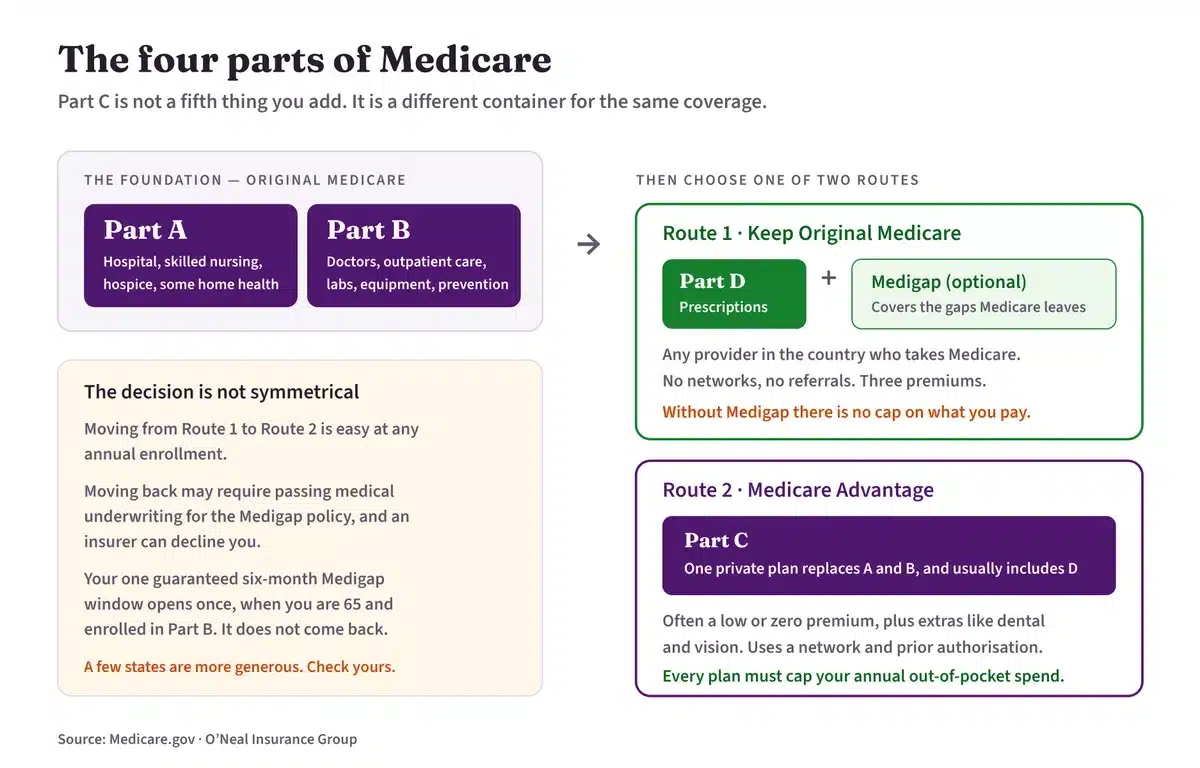
Before you compare Medicare plans within a category, it helps to know which category you are in, because the two routes behave differently.
Medicare Advantage bundles your hospital, medical and usually drug coverage into one private plan with a network and an annual out-of-pocket ceiling. Premiums are often low, extras are common, and you accept network rules and prior authorizations.
Medicare Supplement with a standalone Part D plan keeps you in Original Medicare, so any provider in the country that accepts Medicare accepts you. Costs are predictable and the monthly premium is higher. There is no network to check, which is why the comparison is simpler but the premium comparison matters more.
You cannot hold both at once. Whichever you choose closes the other for as long as you keep it, and switching back later may involve health questions. That is the decision worth spending time on; everything after it is arithmetic.
What star ratings tell you, and what they do not
Medicare publishes a star rating from one to five for Medicare Advantage and Part D plans each year, covering things like preventive care, member complaints, customer service and how quickly plans handle appeals.
Star ratings are a useful tiebreaker when you compare Medicare plans that otherwise look alike. They are not a substitute for the four checks above. A five-star plan that excludes your cardiologist is the wrong plan, and a three-and-a-half-star plan that covers every doctor and drug you use at a lower total cost is usually the right one.
One practical note: a five-star plan can be joined outside the usual windows once per year under a special enrollment period. It is a narrow rule, but occasionally the reason a comparison is worth running in March rather than waiting until October.
Why having an agent of record costs you nothing
Plan prices are set by the insurer and filed with regulators. They are identical whether you enroll yourself online, call the carrier’s national line, or work through a licensed local broker. There is no version of the plan that costs less because you did it alone.
What changes is who you call next year. If you use the secure link on this page, O’Neal Insurance Group becomes your assigned agent of record automatically, at no cost. That means a person who knows your file when a claim is denied, when a bill looks wrong, or when the plan’s Annual Notice of Change lands in the autumn and you need to compare Medicare plans again.
We do not offer every plan available in your area. We represent 30 organizations which offer over 125 products where you live, and you can always contact Medicare.gov, 1-800-MEDICARE, or your State Health Insurance Assistance Program for information on all of your options.
Compare Medicare plans safely: what never to share
The enrollment link on this page is secure. Not everything that reaches you is.
Never give your Medicare number, Social Security number, bank details or medical records to an unsolicited caller, a text message, or a web form you did not go looking for. Medicare does not cold-call people to sell plans. Neither do we.
Send nothing sensitive by email. Use the secure enrollment link, or call the number on this page and confirm you are speaking to a licensed agent. You can verify any agent’s license through your state insurance department or the NAIC lookup below.
Medicare reference charts
The charts below cover the ground most questions start from.
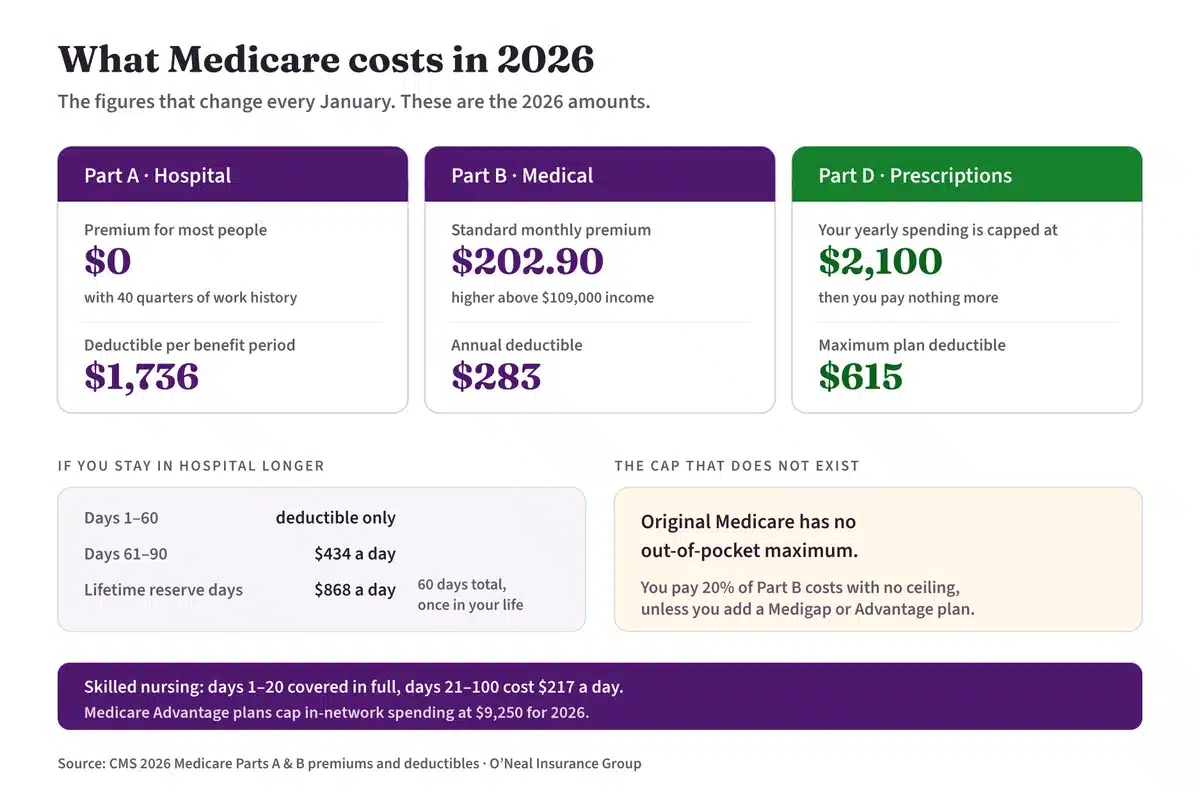
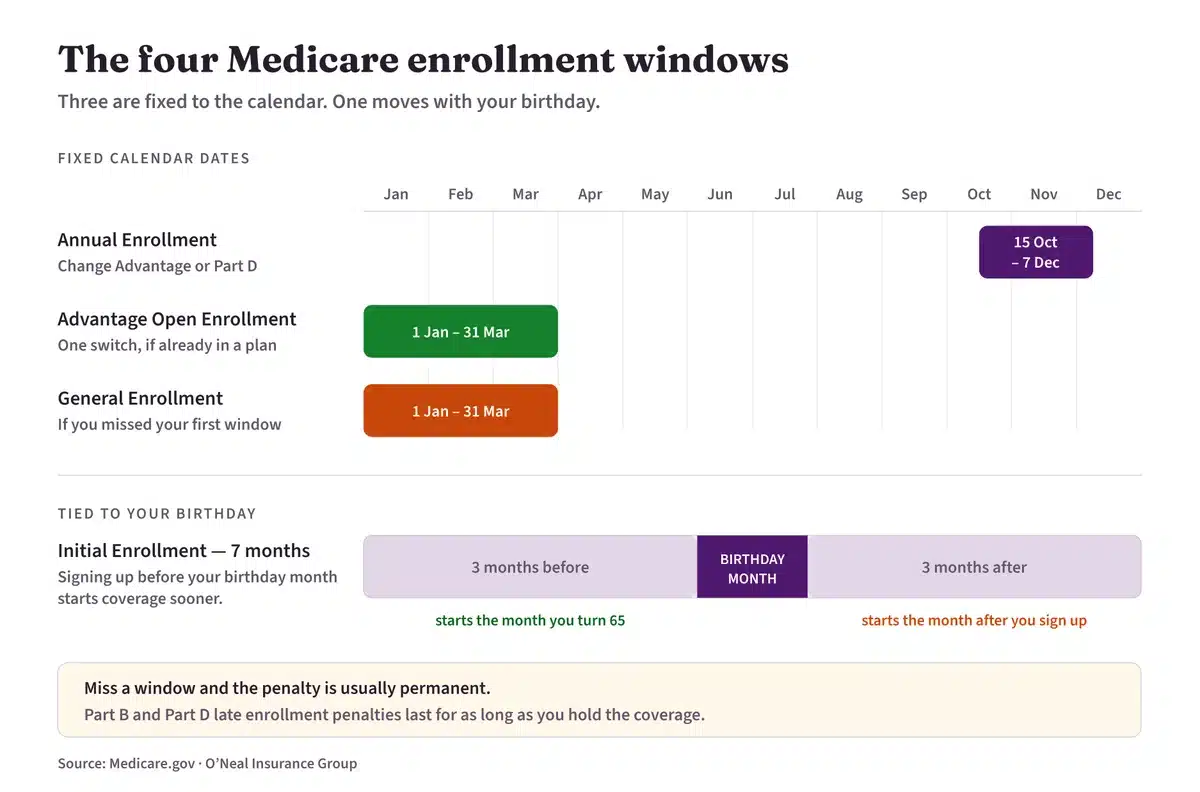
Check any of this independently
You do not have to take our word for any of it.
- Medicare Plan Finder — the official government comparison tool
- Medicare.gov — Part D costs — the 2026 out-of-pocket cap quoted above
- SHIP National Technical Assistance Center — free counseling from people who sell nothing
- NAIC consumer tools — agent license and complaint lookup
Related guides on this site
- Which Medicare enrollment window applies to you — before you compare, check you can act
- Medicare Advantage plans — how the bundled route works
- Medicare Supplement (Medigap) — the predictable-cost alternative
- Part D prescription drug plans — formularies, tiers and the annual cap
- Book a no-cost appointment
Or call (877) 808-2900 and we will compare Medicare plans with you on a screen share, using your own doctor list and your own prescriptions.
Official resource
Doing it yourself: what the Plan Finder shows you
Medicare.gov has a plan comparison tool that is free, official, and better than most people expect. If you want to compare Medicare plans without speaking to anybody, this is the place to do it, and we would rather you used it than a lead-generation site dressed up to look like it.
It works best if you do three things before you start, and they matter more than anything else you will do to compare Medicare plans.
Enter your medications with doses. This is the step people skip and the one that changes the answer most. The tool prices each plan against your actual drug list, including the tier each medication sits on, and reorders the results accordingly.
Choose your pharmacies. Preferred and standard pharmacies are both in network, and the difference between them repeats every month. Adding two or three local options shows you which plan works where you already shop.
Sort by total estimated cost, not by premium. The tool will estimate a yearly figure combining premium, deductible and drug costs. That number is far more useful than the monthly one, and the cheapest premium is regularly not the cheapest year.
What it does not show, and why that matters
The tool is strong on drugs and weak on doctors. Provider directories are maintained by the carriers, not by Medicare, and the tool sends you to the plan’s own directory to check. Those directories are updated on the carrier’s schedule and are frequently out of date.
So the network check is the part you still have to do by telephone. Ring the practice, not just the carrier, and ask whether they are contracted with that specific plan for the coming year. Where a directory and a receptionist disagree, believe the receptionist and get the carrier to confirm in writing.
Three other things sit outside the tool entirely. Prior authorization rules, which decide how easily you get advanced imaging or a procedure approved. The detail of extra benefits, where a dental allowance may be a fixed sum rather than real cover. And Medicare Supplement premiums, which are not sold through the Plan Finder at all — you can see which policies exist in your state, but not compare live rates.
Enrolling yourself, and what happens next
You can enroll directly from the Plan Finder, or by calling 1-800-MEDICARE, or on the carrier’s own site. The premium is identical whichever route you take. Nobody pays more for using an agent and nobody pays less for avoiding one.
Whichever route you use to compare Medicare plans, keep the confirmation number. Expect an acknowledgement before the membership card arrives, and check the effective date and plan name on the card when it does.
Two cautions if you are going it alone. Enrolling in a Medicare Advantage plan automatically ends any Medigap policy you hold, and buying that supplement back later may mean answering health questions. And dropping Part D coverage without other creditable drug coverage starts a permanent late-enrollment penalty after 63 days.
Neither is a reason to avoid self-enrollment. Both are reasons to be sure before you click.
A second opinion that costs nothing
Your State Health Insurance Assistance Program offers free one-to-one counseling from people who sell nothing and earn nothing from your decision. The national directory is at shiphelp.org. For anyone who wants to compare Medicare plans without a commercial interest anywhere in the room, that is the service to use.
We are useful when the household is complicated — two people on different timelines, a specialist worth protecting, income near the assistance limits, or a supplement decision with underwriting consequences. We are not useful when the Plan Finder has already given you a clear answer, and we will say so.
However you compare Medicare plans in the end, do it against your own medication list and your own doctors. Every other method is guesswork dressed up as research.
When the tool is enough, and when it is not
If you take no regular medications, use one or two local doctors and have no supplement to protect, the Plan Finder will usually give you a clear answer in twenty minutes. Take it. There is no prize for involving anybody else.
It gets harder in four situations. When a specialist relationship is worth protecting and directories disagree. When two people in a household reach Medicare on different timelines. When income sits near the assistance limits, because qualifying changes the whole comparison. And when a Medigap decision carries underwriting consequences that cannot be undone later.
Those are the cases where people who compare Medicare plans alone most often get a result they regret, not because the tool is wrong but because the question was never really about price.
Whichever way you go, write down what you decided and why. Next autumn you will be comparing against this year’s reasoning, and it is much easier to compare Medicare plans properly when you can remember what mattered last time.
There is no fee for a second opinion here either, and no obligation to enroll through us if you would rather compare Medicare plans and do it yourself.
Whatever you decide, do it before the mail arrives in October rather than in the middle of it. The work is identical in August and the attention is not.
Check the source, then ask for personal help
Educational information is general. A licensed agent can help with plan comparisons; agents do not provide medical, legal, or official eligibility advice.