
Permanent coverage with policy guarantees
Whole life insurance
Whole life insurance is designed to remain in force for life when required premiums are paid and policy terms are met. It may build cash value under the contract.
Who this coverage may be designed for
- People seeking permanent death-benefit protection
- Families planning for final expenses
- People comfortable with long-term premium commitments
What it generally covers
- A contract-defined death benefit
- Guaranteed cash-value growth in many policies
- Optional riders when available
Important limits and enrollment considerations
- Premiums are generally higher than term coverage
- Loans and withdrawals can reduce benefits
- Underwriting, exclusions, and contestability provisions apply
- Overfunding a policy changes its tax treatment permanently
- Being asked to replace a policy you already own
- Stress-testing an illustration before you sign it
- When the money should not go to a person directly
How whole life insurance actually works
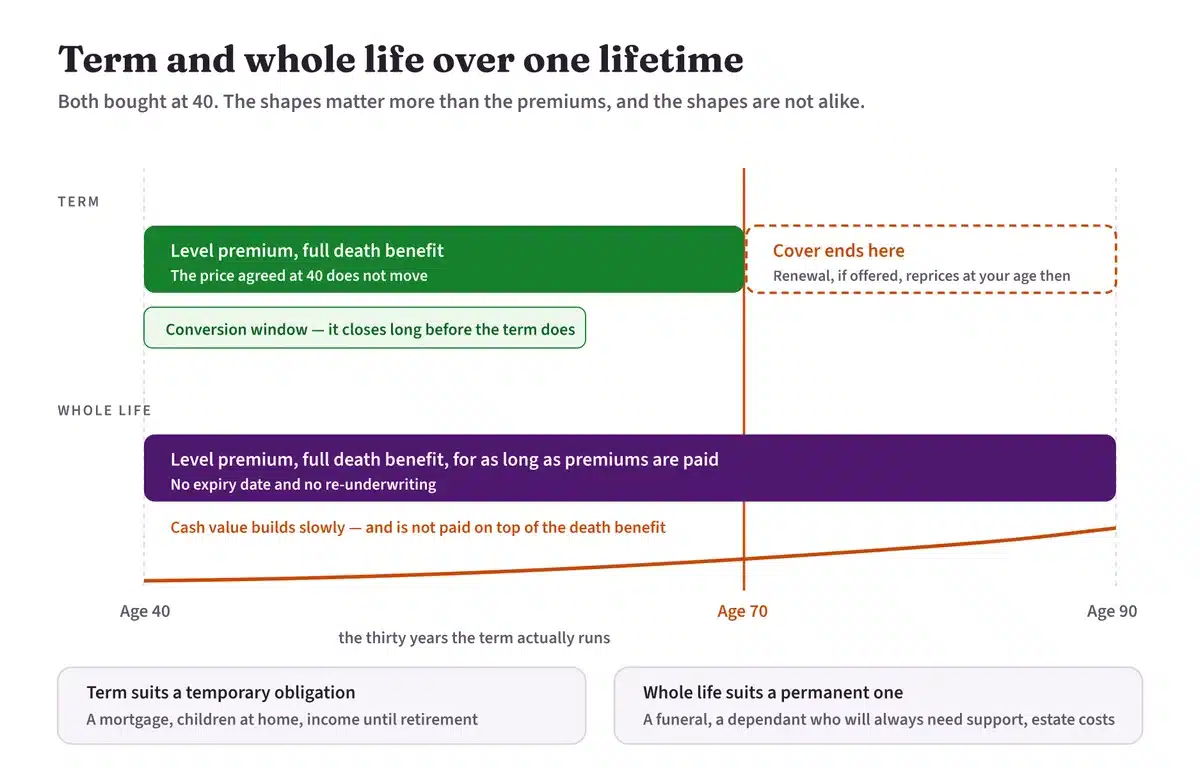
Whole life insurance is permanent cover. Provided the premiums are paid, the policy does not expire and the death benefit is payable whenever death occurs, at 70 or at 100.
Two things are happening inside the contract at once. Part of each premium funds the death benefit. The rest builds cash value, a guaranteed account inside the policy that grows at a rate set in the contract and is not exposed to the stock market.
That second part is why whole life insurance costs several times what an equivalent term policy costs at the same age. You are pre-funding a benefit that is certain to be paid rather than one that probably will not be.
The premium is level for life on most policies. It does not rise as you age, and it does not rise if your health deteriorates.
What the cash value can and cannot do
Cash value accumulates slowly at first. In the early years most of the premium is absorbed by the cost of insurance and acquisition expenses, so a policy surrendered in year three usually returns very little. Whole life insurance rewards patience and punishes short holding periods.
Once it has built up, you can generally do three things with it.
Borrow against it. Policy loans do not require credit approval and are not taxable when taken. They do accrue interest, and any unpaid balance reduces the death benefit.
Withdraw from it. Withdrawals up to the amount you have paid in are usually tax-free; beyond that they may be taxable. Withdrawals permanently reduce the benefit.
Surrender the policy. You take the cash surrender value and the cover ends. Gains above your cost basis are taxable.
What cash value is not is a savings account. Access is slower, the early returns are poor, and the money is not there in an emergency in year two. Treat it as a long-term feature of the insurance, not as an investment.
Participating policies and dividends
Some whole life insurance is issued by mutual companies and is described as participating, meaning the policy may receive an annual dividend when the insurer’s results allow.
Dividends are not guaranteed. Illustrations that project decades of them are showing an assumption, not a promise, and the difference compounds. Ask for the guaranteed column of any illustration and make the decision on that.
Where dividends are paid you can usually take them in cash, use them to reduce premiums, leave them to accumulate at interest, or buy paid-up additions: small increments of extra permanent cover, which is generally the most efficient use of them.
Who whole life insurance genuinely suits
It is the right tool for a need that does not go away. Cover for a dependent with a disability who will need support for life. A lifelong estate-planning or business-succession obligation. Funding a buy-sell agreement.
It also suits people who want a permanent benefit locked in while they are healthy enough to qualify, and who can comfortably afford the premium for decades rather than years.
It is usually the wrong tool for a temporary need. If the obligation ends when the mortgage is paid or the children finish school, term cover buys several times the death benefit for the same money. And if the goal is simply to cover a funeral, a final expense policy is a smaller, cheaper form of the same permanent idea.
Whole life insurance and universal life are not the same
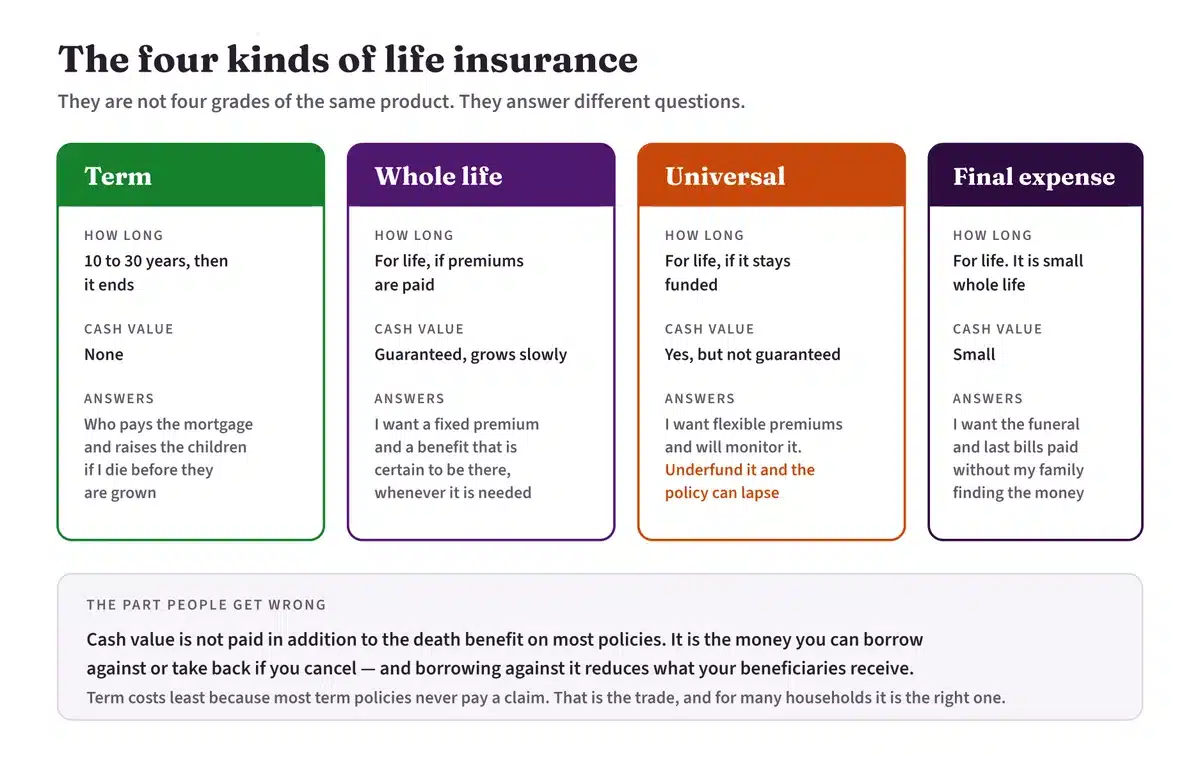
Universal life is also permanent, but the premium is flexible and the interior costs can rise over time. If the policy is underfunded, cash value is consumed to keep it going, and a policy bought at 45 can require far larger payments at 75 to avoid lapsing.
Whole life insurance trades that flexibility for certainty: a fixed premium, a guaranteed death benefit and a guaranteed minimum cash value. If predictability is what you are buying, that distinction is the whole decision.
Applying, and what underwriting looks at
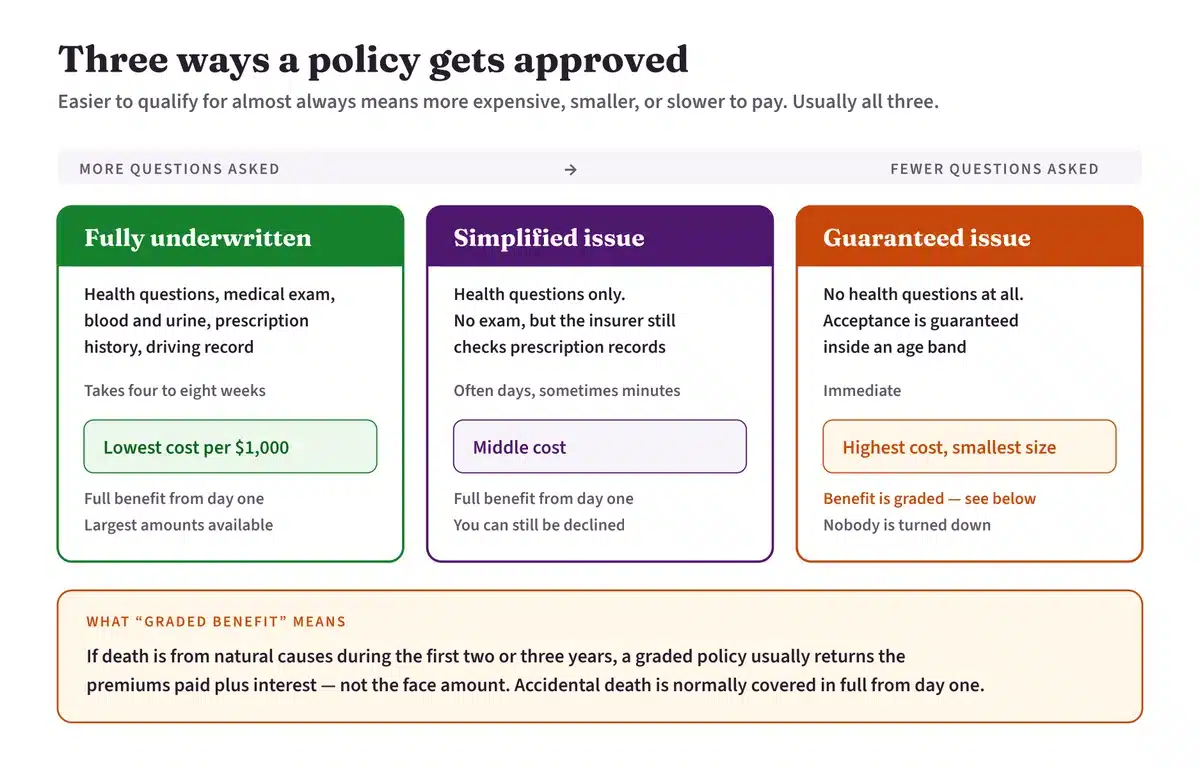
Most whole life insurance is fully underwritten: health questions, a paramedical exam, and a review of prescription and driving records. Some carriers offer simplified issue at smaller face amounts with questions only.
Age and health set the rate class, and the rate is then locked for life. This is why applying earlier matters more with permanent cover than with term: you are fixing a price you will pay for forty years, not ten.
Answer everything accurately. The contestability period, normally two years, lets the insurer review the application if a claim arises during it.
Common mistakes with whole life insurance
Buying more than the budget can sustain. A lapsed permanent policy is the worst outcome available: years of premium spent and no cover. Buy an amount you can pay through a bad year.
Reading the illustration’s projected column as a forecast. Only the guaranteed column is contractual.
Assuming the cash value passes to your family. On most policies the beneficiaries receive the death benefit and the insurer retains the cash value. Ask which option your contract uses.
Letting a loan quietly grow. Unpaid interest compounds and can eventually consume the policy.
What happens if you stop paying
This is where whole life insurance behaves quite differently from term, and where the cash value earns its keep.
Once a policy has built cash value, it carries non-forfeiture options. Stopping payment does not simply cancel the cover.
Reduced paid-up insurance. The cash value buys a smaller permanent death benefit outright. You never pay another premium and the policy remains in force for life at the reduced amount. For someone whose income has fallen in retirement, this is usually the best of the three.
Extended term insurance. The cash value buys term cover at the original death benefit for as long as it will fund. Full benefit, but with an expiry date.
Automatic premium loan. The policy borrows from its own cash value to pay the premium. Useful for a short gap, corrosive if left running for years, because the loan and its interest reduce the benefit.
Which options your whole life insurance contract offers, and how they are calculated, is set out in the policy’s non-forfeiture table. Ask to see it before you buy rather than during a difficult year, and call us before you cancel anything. Permanent cover surrendered late in life is very hard to replace.
Check any of this independently
Nothing here should rest on our word alone.
- NAIC: life insurance consumer information, from the association of state insurance regulators
- NAIC consumer tools: agent license and complaint lookup
- NAIC consumer resources, including how to trace a lost policy
Related guides on this site
- Life insurance overview: term, whole, universal and final expense compared
- Term life insurance and final expense cover
- Medicare Simplified, if you are also approaching 65
- Book a no-cost appointment
Or call (877) 808-2900. We will show you what whole life insurance costs at your age beside the term alternative, and we will tell you plainly when the term policy is the better buy.
Ask before you decide
Frequently asked questions about whole life insurance
Does guidance cost me anything?
No additional fee is charged to you for O’Neal Insurance Group’s guidance. Agents may be compensated by an insurance carrier when an enrollment occurs.
Is every plan available through the agency?
No. The agency does not offer every plan available in every area. Availability depends on location, eligibility, carrier appointment, and product availability.
Official resource
Overfunding a policy changes its tax treatment permanently
There is a limit on how quickly you may pay money into a life policy before the tax code stops treating it as insurance and starts treating it as an investment wrapper. Cross it and the contract becomes a modified endowment contract.
The test is applied over the first seven years, and it is also reapplied if the policy is materially changed later. Nothing about the death benefit changes, and beneficiaries still receive it in the ordinary way. What changes is how money taken out while you are alive is taxed.
In a normal whole life insurance policy, withdrawals come out of what you paid in first and are not taxed until you have taken back more than that. In a modified endowment contract the order reverses: gains come out first and are taxable, and a further penalty can apply to amounts taken before age 59 and a half. Policy loans, which are ordinarily not a taxable event, are treated as distributions too.
The classification is permanent. It cannot be undone by paying less later.
This matters to anyone who intends to pay a policy up quickly, fund it with a lump sum, or add paid-up additions aggressively. Ask the insurer, in writing, whether the funding pattern you are considering keeps the contract outside the limit, and ask again before making any change to a policy you already hold. If the answer is that it will become a modified endowment contract, that may still be the right decision, but it should be a decision rather than a surprise.
Being asked to replace a policy you already own
Sooner or later somebody will offer to move your existing cover into something better. Occasionally that is true. Often it is not, and the person proposing it is paid a new first-year commission either way.
Four things reset when you replace whole life insurance. A new contestability period begins, so a claim in the first two years can be investigated and the policy rescinded for a misstatement. A new suicide clause usually begins with it. New acquisition costs come out of the early premiums, which is why the cash value of a young policy is so poor. And the new policy is priced at your age and health today, not at the age you were when the original was written.
Surrendering an existing policy for cash can also create a taxable gain. A 1035 exchange is the mechanism that lets one life policy be exchanged for another without triggering that tax, and it is worth using where a replacement genuinely is the right answer, but note that any outstanding loan carried through the exchange can itself be treated as taxable.
Most states require a replacement notice and a comparison to be given to you, and give you a window to change your mind. Use it. Ask for the old policy’s current guaranteed values in writing, ask what happens to it if you keep it and simply stop adding to it, and ask what the new policy’s guaranteed column shows at the ages that matter.
Never cancel the old policy until the new one is issued, delivered and paid. People have been left with neither.
Stress-testing an illustration before you sign it
An illustration is a projection built on assumptions the insurer is allowed to make. Reading only the column that flatters it is how people end up disappointed twenty years later.
Ask for three versions of the same proposal. One at the guaranteed values only. One at the current dividend or crediting scale. And one at something between the two, because the honest expectation usually sits there rather than at either end.
Then ask three questions of the guaranteed version. What is the death benefit at 85 and at 95. What is the cash surrender value at ten, twenty and thirty years. And what happens if premiums stop at 70: does the policy stay in force on its own, and at what reduced amount.
If a proposal only works when the non-guaranteed assumptions hold, it is not a plan. Whole life insurance is bought for certainty, so buy the amount the guaranteed column supports and treat anything above it as a bonus.
When the money should not go to a person directly
Permanent cover is often bought precisely because someone will still need looking after when it pays. That makes who receives it a more delicate question than it looks.
A lump sum paid outright to a person receiving means-tested benefits (Medicaid, Supplemental Security Income, certain housing and food assistance) can disqualify them until it is spent down. Families intending to protect an adult child with a disability sometimes achieve the opposite by naming them directly. A properly drafted special needs trust, named as beneficiary rather than the person, is the usual answer, and it is legal work rather than insurance work.
Naming a minor child directly causes a different problem, because an insurer cannot pay a minor and a court-appointed arrangement takes over. Naming your estate causes a third, because the money then passes through probate and is exposed to creditors instead of going straight to a named person.
Review the beneficiary designation after any marriage, divorce, birth or death in the family. The designation on the policy governs, and it beats whatever the will says.
We will not draft a trust for you, and we will say so plainly rather than pretend otherwise. What we will do is make sure the whole life insurance policy is structured so that a trust your attorney sets up can be named cleanly when the time comes.
Bring the policy documents rather than the annual statement. The contract is where the guarantees live, and a whole life insurance decision made from a summary page is a decision made half-blind.
Check the source, then ask for personal help
Educational information is general. A licensed agent can help with plan comparisons; agents do not provide medical, legal, or official eligibility advice.
Personal guidance · No additional fee