
California Medicare guidance
Medicare plans California: Compare What You Can Actually Join
O'Neal Insurance Group helps Californians compare the Medicare plans California offers alongside other insurance coverage with a licensed agent serving the state. The review turns on county, ZIP code, providers, medications, eligibility and priorities.
- Independent Medicare guidance
- Your own personal broker contact
- No-cost consultation
- Licensed agent support
Medicare plans California: one state, many markets
The Medicare plans California offers in Los Angeles County differ from those in San Diego, the Inland Empire, the Bay Area or the Central Valley. A large health system may participate under only certain contracts. Rural and mountain communities face a different problem: a directory entry is useless if the provider is far away or not taking new patients. Every meaningful comparison begins with the permanent residential ZIP code and county, followed by direct checks of the Medicare plans California offers against your doctors, hospitals, pharmacies and prescriptions.
A personal agent holds one list of those details while comparing the Medicare plans California offers, and explains the tradeoffs plainly. Before plan-specific marketing, an agent may ask you to complete a Need Analysis and, when federal rules call for it, a Scope of Appointment. The Need Analysis records coverage requirements and likely use. The Scope lists the categories you agreed to discuss. It is not permission to enroll you.
Compare the Medicare plans California with a licensed agent broker serving the state. Review the Medicare plans California offers annually, because premiums, cost sharing, formularies, provider contracts and supplemental benefits all change. Dual-eligible coordination also deserves a fresh county check as Medi-Medi availability expands.
Where the Medicare plans California offers differ by city
- Los Angeles — 3,869,089. Los Angeles County contains many medical systems and plan networks. Verify the exact physician group, hospital and plan contract rather than relying on a carrier name alone.
- San Diego — 1,406,106. San Diego County residents should compare local networks, prescriptions and cross-border or out-of-area care patterns before choosing an HMO or PPO.
- San Jose — 989,814. Santa Clara County beneficiaries often navigate large integrated systems and independent groups; confirm every provider under the exact plan.
- San Francisco — 826,079. San Francisco is both a city and county. Compact geography does not eliminate network, referral or prior-authorization differences.
- Fresno — 555,549. Fresno County residents may use the city as a regional specialty hub, making facility and specialist verification especially important.
- Sacramento — 536,449. Sacramento-area provider systems extend across county lines, but Medicare Advantage service areas and benefits remain county-specific.
- Long Beach — 450,469. Long Beach shares Los Angeles County’s plan market, yet the most practical network may differ from one used elsewhere in the county.
- Oakland — 440,838. Alameda County residents should check East Bay hospital access, physician groups and the cost of out-of-network PPO use.
- Bakersfield — 422,165. Kern County choices are not represented by the Los Angeles list. Verify local specialists, hospitals, pharmacies and travel for care.
- Anaheim — 341,008. Orange County residents should compare provider groups and Medi-Cal alignment carefully when evaluating a D-SNP or Medi-Medi Plan.
Why the Medicare plans California offers change by county
- Los Angeles County — 9,694,934: Los Angeles, Long Beach, Glendale and Santa Clarita are major communities. MA, D-SNP, C-SNP, network, formulary and supplemental-benefit availability varies by plan and ZIP code.
- San Diego County — 3,282,248: San Diego, Chula Vista, Oceanside and Escondido residents should verify county offerings and the exact medical-group relationship.
- Orange County — 3,149,507: Anaheim, Santa Ana, Irvine and Huntington Beach have numerous provider organizations; participation must be checked plan by plan.
- Riverside County — 2,544,916: Riverside, Moreno Valley, Corona and Temecula residents should consider travel distance, specialist availability and county-specific SNP options.
- San Bernardino County — 2,224,091: San Bernardino, Fontana, Rancho Cucamonga and Ontario are spread across a large county. A usable network matters more than a long directory.
- Santa Clara County — 1,914,391: San Jose, Sunnyvale, Santa Clara and Mountain View residents should verify integrated-system and physician-group participation.
- Alameda County — 1,636,630: Oakland, Fremont, Berkeley and Hayward residents may see different D-SNP alignment and provider arrangements than nearby counties.
- Sacramento County — 1,618,460: Sacramento, Elk Grove and Folsom residents should check both the county plan list and preferred regional health systems.
- Contra Costa County — 1,170,070: Concord, Richmond, Antioch and Walnut Creek residents need county-specific checks for networks, prescriptions and supplemental benefits.
- Fresno County — 1,035,456: Fresno, Clovis, Sanger and Reedley residents may rely on regional specialists; compare referral and authorization requirements carefully.
Understanding the Medicare plans California actually offers
Original Medicare is the federal program. Part A covers inpatient hospital, skilled nursing, hospice and certain home health care. Part B covers physician services, outpatient treatment, preventive care and durable medical equipment. A stand-alone Part D plan can add prescription coverage.
Medicare Advantage (Part C) is private coverage approved by Medicare that delivers Part A and Part B benefits, usually through a service area and network. Many plans include Part D and may offer extra benefits. Medigap supplements certain Original Medicare cost sharing and cannot be used with Medicare Advantage. Hospital indemnity and critical illness are separate limited-benefit products, not Medicare.
| Coverage option | How it works | Provider access | Prescription coverage | Possible additional benefits | Fitness membership | Flex card | Important considerations |
|---|---|---|---|---|---|---|---|
| Original Medicare | Federal Parts A/B | Medicare-participating providers | Add Part D | Primarily Medicare-covered care | Not standard | No | No annual Part A/B out-of-pocket cap |
| Medicare Advantage | Private plan provides Parts A/B | County service area and network | Often included | Dental, vision, hearing, OTC or other benefits may apply | Plan-specific | Plan-specific | Check physician group, hospital, formulary, approvals and MOOP |
| Medigap with Original Medicare | Helps with selected Original Medicare costs | Original Medicare access | Separate Part D usually needed | Few MA-style extras | Policy-specific, if any | No standard card | Premium, enrollment rights and underwriting rules matter |
| Stand-alone Part D | Private prescription coverage | Pharmacy network | Yes | Drug coverage only | No | No | Formulary, tiers and restrictions vary |
| Indemnity / critical illness | Pays contract-defined benefits | Contract-specific | Not comprehensive | Separate limited benefits | No | No | Not Part of Original Medicare or major medical insurance |
HMO and PPO Medicare plans California residents can join
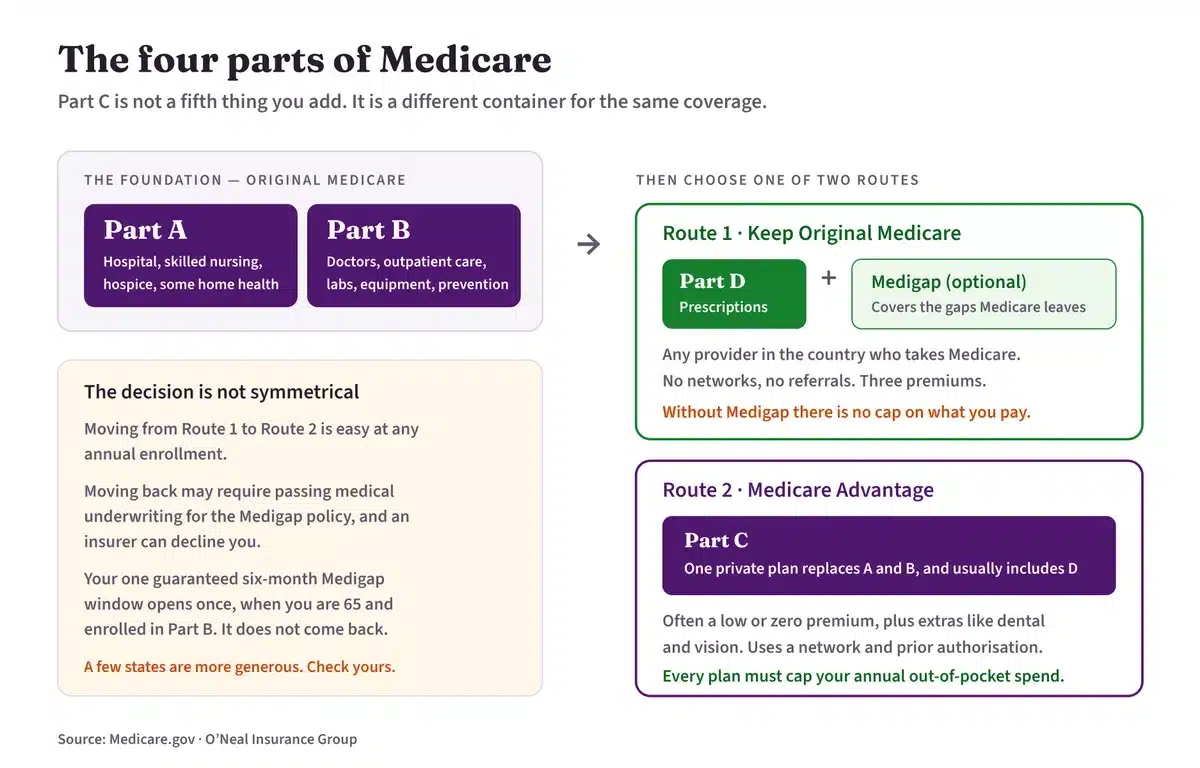
Among the Medicare plans California offers, an HMO expects members to use network providers and may organize care through a primary doctor, medical group or referral process. A PPO generally offers more out-of-network flexibility at different costs. That flexibility does not guarantee a noncontracted provider will accept the plan.
California provider relationships are layered: carrier, plan, medical group and hospital affiliation all matter. Confirm each level against the Medicare plans California offers, along with pharmacies and prescriptions. Review the formulary, drug tiers, prior authorization, step therapy, cost sharing and the in-network out-of-pocket maximum. Among the Medicare plans California offers, neither HMO nor PPO is automatically the right answer.
Special Needs Plan Guidance
D-SNPs and Medi-Medi Plans
D-SNPs require Medicare, Medi-Cal and plan eligibility plus county availability. California calls its integrated Exclusively Aligned Enrollment D-SNPs Medi-Medi Plans. DHCS reports that Medi-Medi Plans are open in 41 counties in 2026—not all 58. Enrollment and benefits depend on Medi-Cal status, plan alignment and service area.
C-SNPs
C-SNPs serve people with plan-approved chronic conditions. Diabetes, chronic heart failure and certain cardiovascular conditions are common examples. A qualifying condition must be confirmed and the plan must be offered in the person’s county.
I-SNPs
I-SNPs may serve eligible residents of certain institutions or people meeting equivalent level-of-care requirements. CMS data shows selected California I-SNP offerings in 2026. Availability and eligibility are not statewide.
Help for People With Medicare and Medi-Cal
California’s Medicaid program is Medi-Cal. Full duals have Medicare and full-scope Medi-Cal; partial duals may receive help through a Medicare Savings Program without full Medi-Cal benefits. DHCS identifies QMB, SLMB, QI and QDWI categories, each with different assistance and eligibility rules.
A D-SNP or Medi-Medi Plan may coordinate Medicare and Medi-Cal, but the person’s Medi-Cal managed care alignment and county matter. Verify eligibility through the county Medi-Cal office or DHCS and, when appropriate, Social Security. An insurance agent does not decide Medi-Cal or MSP eligibility.
LIS and Extra Help
Low-Income Subsidy and Extra Help are the same federal Part D program, reducing premiums, deductibles and cost sharing. Do not assume qualification from age or Medi-Cal status alone. O’Neal Insurance Group can help explain the application and plan-comparison steps.
Veterans and the Medicare plans California offers
VA health care and Medicare are separate. A veteran may keep VA care while using Medicare for non-VA services, but Part C does not replace the VA. Check where prescriptions are filled and whether non-VA clinicians are in network.
TRICARE For Life generally coordinates with Medicare for eligible beneficiaries. Check proposed changes directly with the VA or TRICARE before they affect military benefits.
Part B Giveback and Flex Card Benefits
A Part B giveback reduces what an eligible enrollee pays toward the Part B premium under a particular plan. It is not cash and may be unavailable at a person’s address.
Flex cards are governed by the plan. Approved categories, allowance amounts, retailers and deadlines vary. The same is true of dental, vision, hearing, transportation, fitness, OTC, food, utility and other supplemental benefits; restrictions can include eligibility, network, frequency and approved use.
Part B premium reductions, flex cards, and other supplemental benefits are not included with every Medicare Advantage plan. Availability, eligibility, benefit amounts, approved expenses, and participating locations vary by plan and service area.
Insurance companies behind the Medicare plans California offers
The CMS July 2026 file shows selected California plans marketed under Aetna Medicare, Alignment Health Plan, Anthem Blue Cross brands, Humana, Molina Healthcare of California, SCAN Health Plan, UnitedHealthcare and Wellcare; it also shows HealthSpring stand-alone Part D products. Plan type and county differ, and this list does not prove an O’Neal Insurance Group appointment.
Carrier and product availability varies by state, county, ZIP code, eligibility, and plan year. Contact O’Neal Insurance Group to learn which companies and plans are currently available in your area.
Cover beyond the Medicare plans California offers
- Individual/family health: Major medical coverage outside Medicare, often compared for people under 65.
- Life: Pays a named beneficiary under the policy terms.
- Final expense: Life insurance commonly evaluated for funeral and related costs.
- Dental and vision: Separate coverage for defined services; neither is Part of Original Medicare.
- Critical illness: Limited benefits for covered diagnoses, with policy definitions and exclusions.
- Cancer, heart attack and stroke: Condition-specific coverage, not comprehensive medical insurance.
- Hospital indemnity: Set benefits for covered hospital events under a separate policy.
- Accident: When available, benefits for specified accidental injuries.
How a licensed agent narrows the Medicare plans California offers
A licensed agent can review enrollment periods, compare costs, verify providers and pharmacies, check formularies, discuss Medi-Cal, MSP or Extra Help, compare HMOs, PPOs and SNPs, and submit an enrollment request once you decide. An agent cannot determine government eligibility.
How to compare the Medicare plans California offers in seven steps
- Confirm Medicare eligibility and enrollment timing.
- Confirm Medi-Cal status or contact the county about possible eligibility.
- Enter the permanent residential ZIP code and county for an online instant comparison.
- List doctors, medical groups, hospitals, pharmacies, every prescription, assistance status and VA use.
- Compare premiums, deductibles, copayments, coinsurance, networks, formularies and maximum out-of-pocket limits.
- Check SNP requirements, Medi-Cal alignment and every supplemental-benefit rule.
- Request enrollment only after selecting a plan and reading official plan materials.
Frequently Asked Questions
What Medicare Advantage plans are available in California?
Availability depends on county, ZIP code, eligibility and plan year. California is not a single statewide Medicare Advantage market.
Why do my medical group and hospital both matter?
A physician may be listed while the desired medical group or hospital relationship is not available under the exact plan. Verify all layers.
Who may qualify for a C-SNP?
A person needs a plan-approved qualifying chronic condition and a C-SNP offered in the residential county.
Can I keep VA health care and enroll in Medicare?
Many veterans keep both systems, but they remain separate. Confirm prescriptions, referrals and military-benefit effects with the VA or TRICARE.
Can an agent help me enroll at no cost?
O’Neal Insurance Group offers a no-cost consultation. A licensed agent may submit an application after you choose; Medicare and the carrier make the enrollment determination.
What information should I prepare?
Gather Medicare details, residence and county, providers, medical groups, hospitals, drugs, pharmacies, current coverage, Medi-Cal notices and military-benefit information.
Need help comparing the Medicare plans California makes available?
Call (877) 808-2900 or contact O’Neal Insurance Group online. A licensed agent can review available options using your ZIP code, county, eligibility, prescriptions, doctors and coverage priorities.

The California birthday rule, and how the 60 days are counted
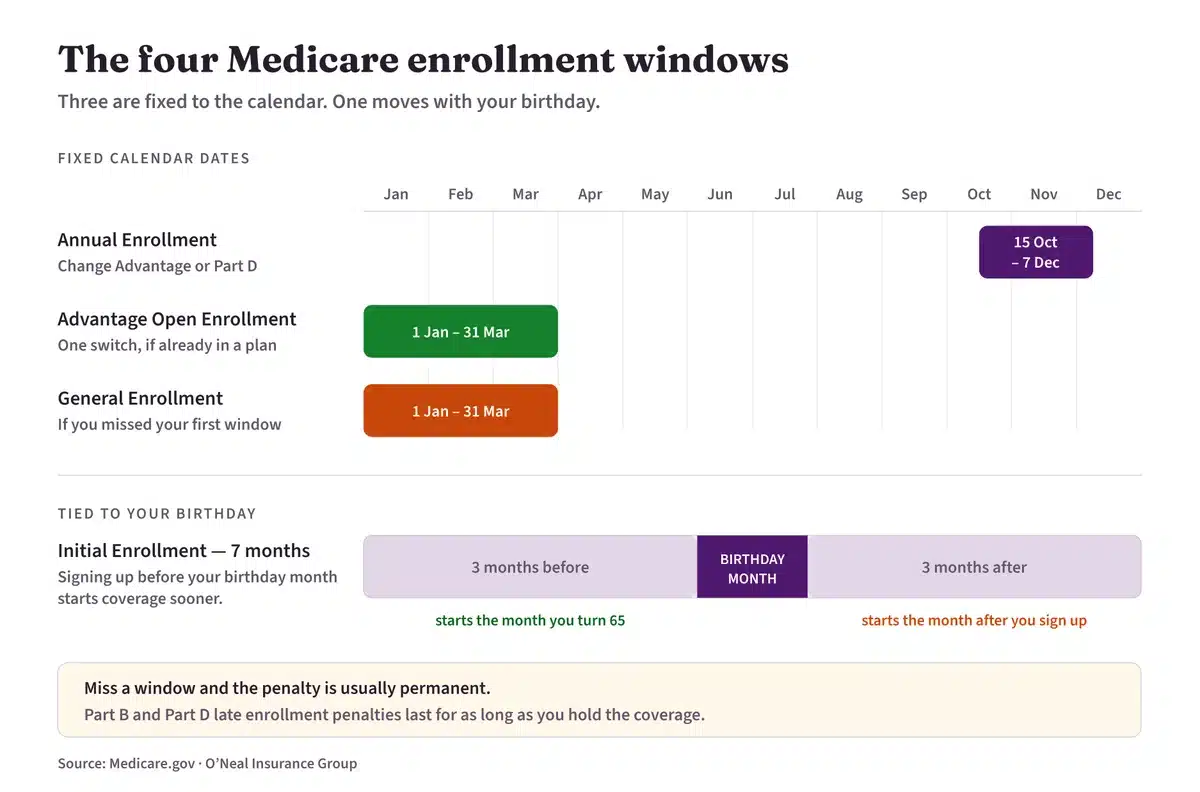
California has one of the longest-standing and most useful Medigap birthday rules in the country. The detail people get wrong is when the clock starts.
The window is 60 days beginning on the first day of your birth month — not on your birthday itself. If you were born on June 20, your window opens on June 1, not the 20th. That is nearly three extra weeks people routinely waste.
Inside the window you can move to another insurance company’s Medigap policy with the same or a lower level of benefits, without medical underwriting.
Being able to change carrier is what makes the California rule powerful. Medigap policies carrying the same letter cover the same things by law, so an annual right to move between companies is a right to re-shop price on identical coverage.
What the rule does not allow is an upgrade. Moving to a richer benefit level still requires answering health questions.
County matters enormously for the other half of the decision. Medicare Advantage networks and availability differ sharply between a dense coastal county and a rural inland one, so a plan a relative recommends may not exist at your address at all.
You can verify any agent’s license and read the state rules at the California Department of Insurance.
Prescription costs and the 2026 cap
For most people the drug list, not the premium, decides which of the Medicare plans California offers is right.
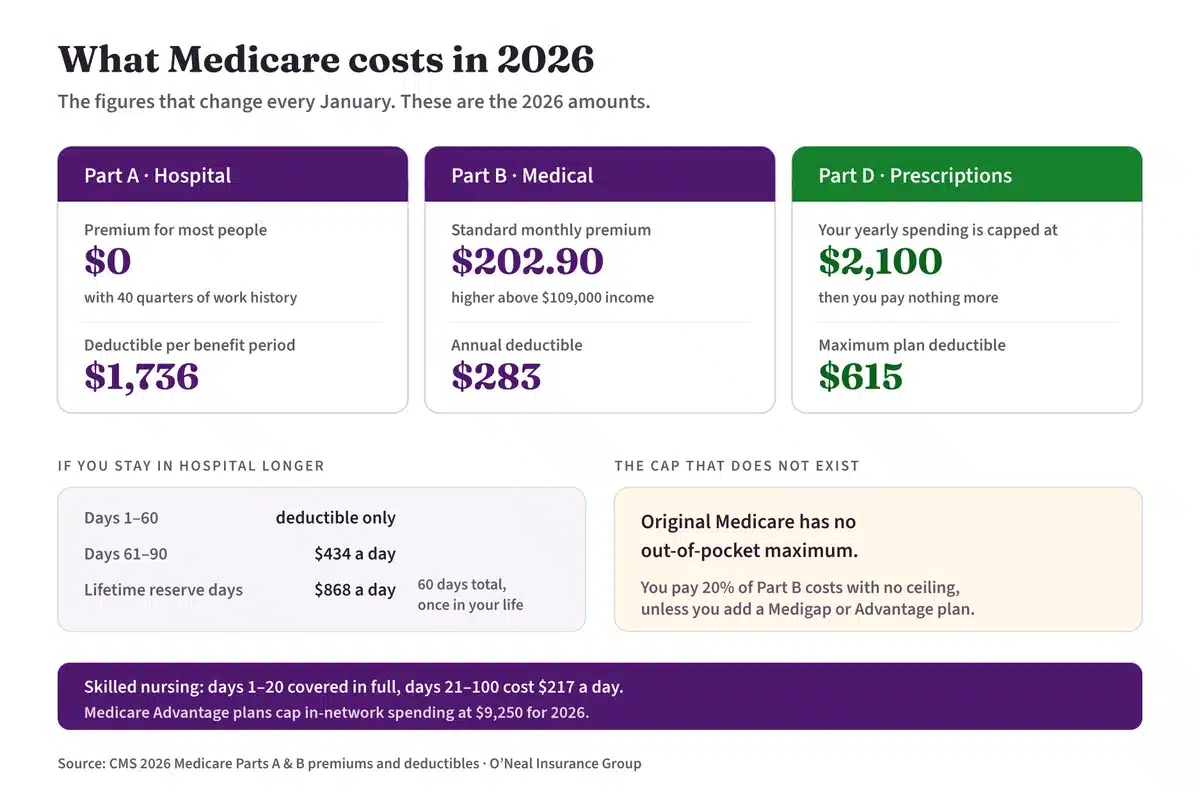
There is now a hard ceiling. Once out-of-pocket spending on covered Part D drugs reaches $2,100 in 2026, you enter catastrophic coverage and pay nothing further for covered drugs that calendar year. No Medicare drug plan may charge a deductible above $615 in 2026.
Check whether each medication is on the formulary at all, what tier it occupies, and which pharmacies near you are preferred rather than merely in-network. Current figures are on Medicare.gov’s Part D cost page, and our Part D guide explains the phases.
Free help that earns nothing from your decision
Before committing to any of the Medicare plans California carriers sell, get a second opinion from someone with no financial stake in the outcome.
California’s free Medicare counseling runs through HICAP, the Health Insurance Counseling and Advocacy Program, on 1-800-434-0222. Medicare.gov Plan Compare lists every plan at your ZIP code, and you can check Extra Help eligibility through the Social Security Administration.
Our guides to Medicare Advantage plan types, what Medicare Advantage costs and enrollment periods go deeper than this page can.
Sources used on this page
- Medicare.gov Plan Compare — official plan availability by county
- California Department of Insurance — Medigap regulation and license lookup
- HICAP, the Health Insurance Counseling and Advocacy Program, on 1-800-434-0222 — free, unbiased Medicare counseling
Whichever way you lean, compare the Medicare plans California offers against your own doctors, prescriptions and budget before enrolling — and remember that the Medicare plans California offers change every year even when your circumstances do not.
How the Medicare plans California offers compare with neighbouring states
Medigap switching rights vary sharply from state to state, and advice written for one state is often simply wrong in another. Because the Medicare plans California offers sit inside California’s rules, it is worth seeing where the state stands.
| State | Annual switching window | Change carrier? | Limit on new policy |
|---|---|---|---|
| California | 60 days from the first of your birth month | Yes, any carrier | Equal or lesser benefits |
| Indiana | 60 days from your birthday (new 1 Jan 2026) | Yes, any carrier | Same plan letter |
| Missouri | 30 days either side of your policy anniversary | Yes, any carrier | Same plan letter |
| Illinois | 45 days from your birthday, ages 65–75 only | No — same insurer or affiliate | Equal or lesser benefits |
| Alabama | None | — | — |
Two lessons follow. A relative in another state who re-shopped Medigap without underwriting tells you nothing about the Medicare plans California offers. And if you move across a state line in retirement, the switching rights you relied on may not travel with you.
None of this affects Part C or Part D, chosen fresh each Annual Enrollment Period. It applies only to Medicare Supplement policies.
Required Disclosures
Not all carriers, products, benefits, or plans represented by O’Neal Insurance Group are available in every state, county, ZIP code, or service area. Plan availability and benefits may change each plan year. Please call or contact us to learn more about the options currently available in your area.
O’Neal Insurance Group is not connected with or endorsed by the United States government, the federal Medicare program, or any state Medicaid program.
“We do not offer every plan available in your area. Currently we represent 30 organizations which offer over 125 products in your area. Please contact Medicare.gov or 1-800-MEDICARE to get information on all of your options.”
Information reviewed August 1, 2026.