
A smaller permanent-life benefit
Final expense and burial insurance
Final expense coverage is usually whole life insurance with a smaller death benefit intended to help beneficiaries with funeral, burial, and other end-of-life expenses.
Who this coverage may be designed for
- People seeking a modest permanent benefit
- Families planning for funeral or burial costs
- Applicants considering simplified underwriting
What it generally covers
- A death benefit paid to the named beneficiary
- Lifetime coverage when policy terms are met
- Cash value in many policies
Important limits and enrollment considerations
- Graded benefits may apply in early policy years
- Premium and eligibility depend on age and health
- The beneficiary controls use of proceeds unless arrangements say otherwise
- Three ways to fund a funeral
- How this interacts with Medicaid
- The arithmetic nobody shows you
What final expense insurance actually is
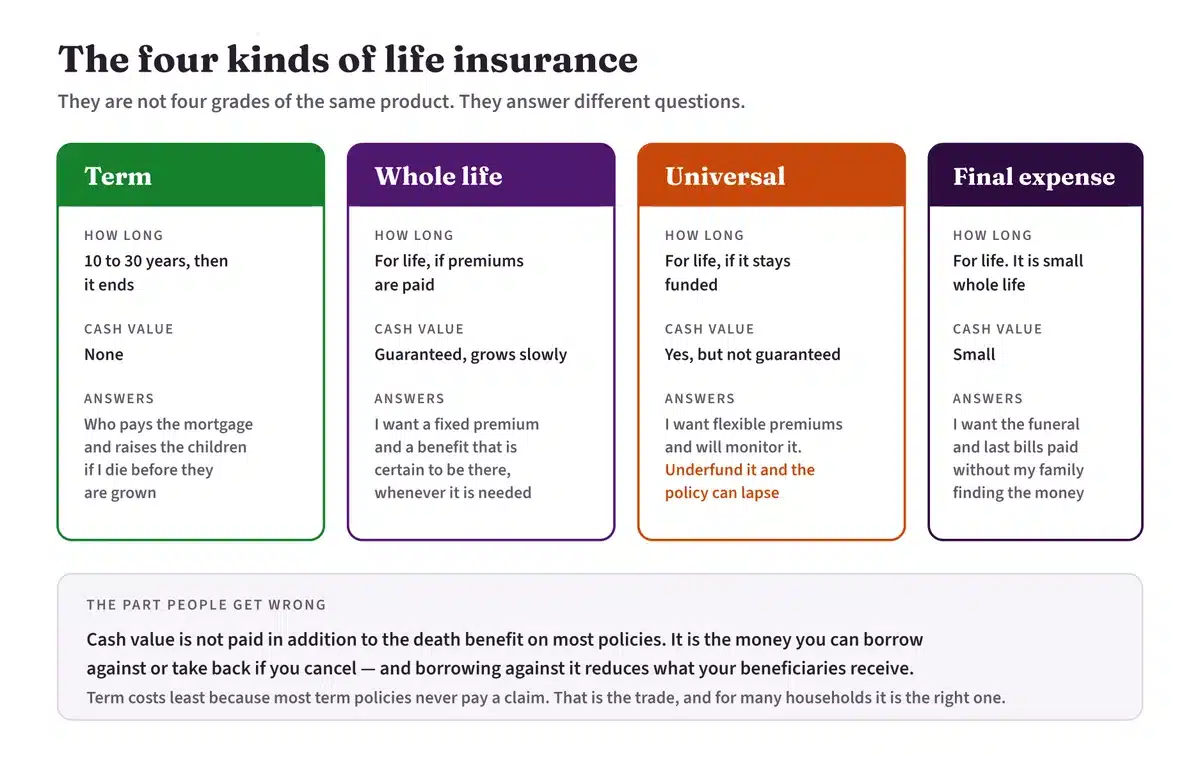
Final expense insurance is a small permanent life policy designed to cover the costs that arrive in the weeks after a death: the funeral or cremation, the burial plot, outstanding medical bills, and the ordinary household debts that do not stop when someone dies.
Face amounts are modest by design. Most policies are written between a few thousand dollars and around twenty-five thousand, because that is the range the need actually occupies.
Like other permanent cover, final expense insurance does not expire while premiums are paid, and the premium is level for life. Unlike a term policy, there is no date on which it disappears. That matters, because this is a need that only becomes more likely with time.
Why it is easier to qualify for
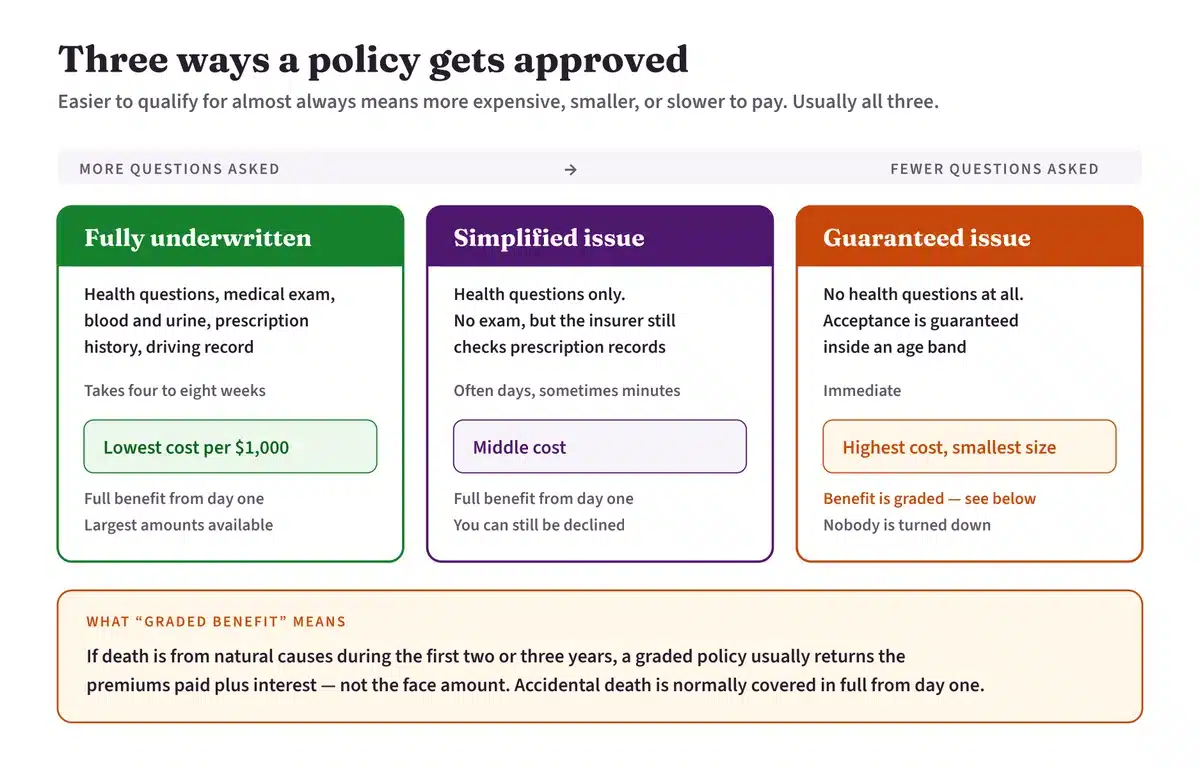
The distinguishing feature of final expense insurance is the underwriting. There is no paramedical exam. Instead you answer a set of health questions, and the carrier checks prescription records.
That opens the door to people who would struggle with a fully underwritten policy: applicants in their seventies, people managing diabetes or heart conditions, people who have had cancer. It is often the only life cover available to them, and it is genuinely useful for that reason.
The trade is price per dollar of benefit. Final expense insurance costs more per thousand dollars of cover than a fully underwritten policy would for a healthy applicant. If you are in good health and want a larger benefit, ask us to quote a standard policy alongside it before you decide.
Level, graded and modified benefits
This is the single most important thing to understand, and the thing most often glossed over.
Level benefit. The full death benefit is payable from day one. This is what you want, and most reasonably healthy applicants qualify for it.
Graded benefit. The policy pays a reduced percentage of the benefit if death occurs in the first two or three years, rising to the full amount afterwards.
Modified or guaranteed issue. No health questions at all, but if death occurs within the first two years the policy typically returns only the premiums paid plus interest, not the death benefit. Accidental death is usually covered in full from the start.
Advertising for final expense insurance rarely distinguishes between these. A family expecting a payout and receiving a refund of premiums instead is a bad afternoon that a single question at the application stage would have prevented. Ask which type you are being offered and get the answer in writing.
Who final expense insurance suits
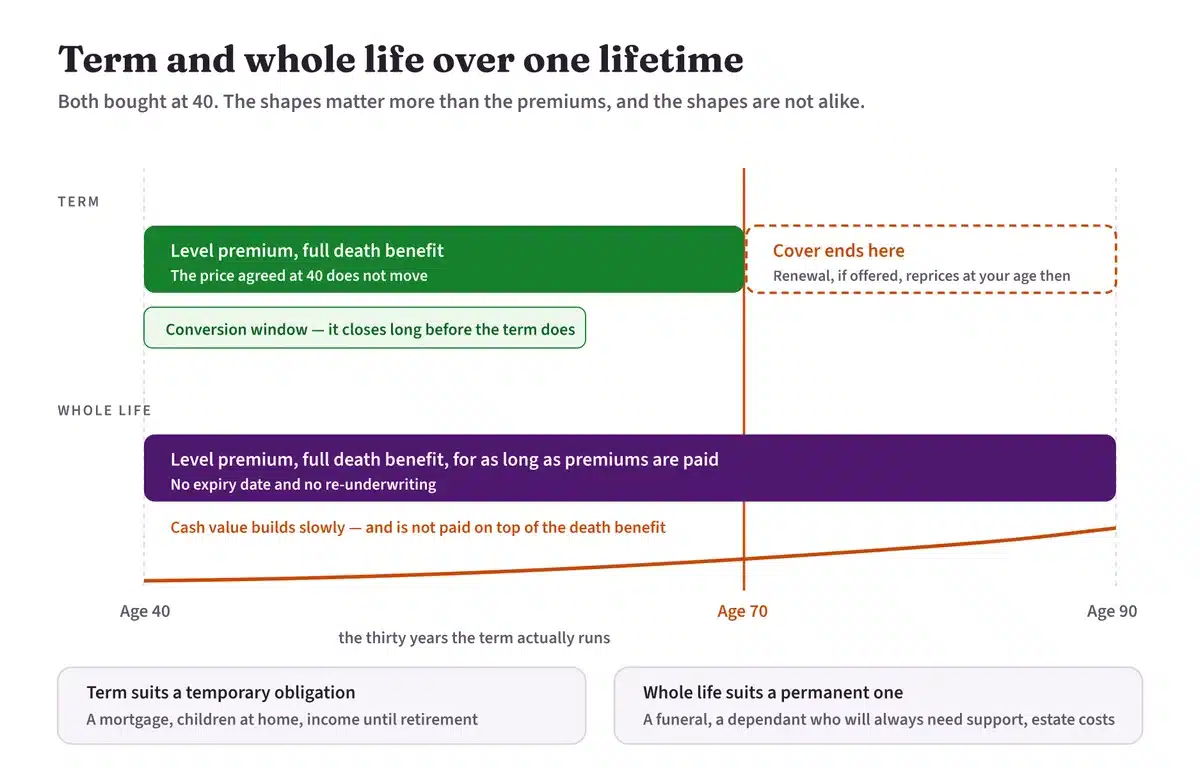
It suits people whose remaining insurance need is small and specific. The mortgage is paid, the children are grown, and what is left is the wish not to hand a bill to the family.
It suits people who cannot pass full underwriting but can answer a short health questionnaire honestly and qualify for a level benefit.
And it suits people who want the certainty of permanent cover at a premium that fits a fixed retirement income.
It does not suit someone still replacing an income. If a household would struggle without your earnings, the need is far larger than a funeral, and term cover buys many times the benefit for the same money.
How the money actually reaches the funeral home
A final expense insurance policy pays cash to the beneficiary you name. It is not tied to any particular funeral home and it does not have to be spent on a funeral at all.
That flexibility is usually an advantage, but it puts weight on who you name. Name a person who will actually be present and organized in the days after your death, and tell them the policy exists. An unclaimed policy helps nobody.
Some people prefer to assign a portion of the benefit directly to a funeral provider so the arrangements are paid without the family fronting money. That is a separate arrangement from a pre-need or pre-paid funeral contract, which is regulated differently and is not insurance in the same sense. If you already hold one, tell us before buying, so you do not pay twice for the same thing.
Common mistakes with final expense insurance
Assuming any policy pays immediately. Graded and modified policies do not. Confirm which you have.
Buying from a mailer without comparing. Rates for the same health profile vary materially between carriers, and the difference is not visible from one quote.
Over-insuring. Work out the actual expected cost in your area, add a margin, and buy that. Paying premiums for decades on a benefit twice the size of the need is money leaving the household every month.
Letting it lapse to save money in a tight year. Permanent cover surrendered late in life is very hard to replace. Talk to us before canceling; reducing the face amount is often possible.
Not telling anyone. Keep the policy number where the family will find it.
Sizing a final expense insurance policy properly
Do not guess at the amount, and do not accept a round number from an advertisement. Price the actual need where you live, because funeral costs vary widely by region and by what you choose.
Under the FTC’s Funeral Rule, any funeral provider must give you an itemised General Price List on request, in person and free of charge, and must quote prices over the telephone. You are entitled to buy only the items you want rather than a package.
Ring two or three providers near you and ask for that list. Add up the items your family would realistically choose: the service, the casket or cremation, the plot or urn, the transport, the death certificates. Then add a margin for the ordinary bills that arrive in the same month, and buy final expense insurance in that amount.
Two things people forget. Cemetery and crematorium charges are usually separate from the funeral home’s own bill. And if you already hold a pre-need or pre-paid funeral contract, part of the cost may already be covered, in which case a smaller final expense insurance policy will do.
Sizing it this way usually produces a lower number than the one people assume, which means a lower premium every month for the rest of your life. It also gives your family a figure they can act on rather than a guess, and it makes the final expense insurance quote we bring you something you can check line by line.
Check any of this independently
- NAIC: life insurance consumer information, from the state insurance regulators’ association
- FTC: shopping for funeral services, covering your rights under the Funeral Rule, including itemised pricing
- NAIC consumer tools: agent license and complaint lookup
- NAIC consumer resources, including how to trace a lost policy
Related guides on this site
- Life insurance overview: how the four main types compare
- Whole life insurance and term life insurance
- Medicare Simplified, for the health side of the same conversation
- Book a no-cost appointment
Or call (877) 808-2900. We will tell you which benefit type you qualify for before you apply, not after.
Ask before you decide
Frequently asked questions about final expense and burial insurance
Does guidance cost me anything?
No additional fee is charged to you for O’Neal Insurance Group’s guidance. Agents may be compensated by an insurance carrier when an enrollment occurs.
Is every plan available through the agency?
No. The agency does not offer every plan available in every area. Availability depends on location, eligibility, carrier appointment, and product availability.
Official resource
Three ways to fund a funeral, and what each one really does
Final expense insurance is one of three common answers. They behave differently enough that choosing between them matters more than choosing between carriers.
A final expense insurance policy. You pay premiums, a named beneficiary receives cash, and the money can be spent on anything. It is portable: move house, move state, change your mind about the arrangements, and the policy is unaffected. It does not guarantee the price of anything, so if funeral costs rise faster than expected the benefit covers less than it once would have.
A pre-need or pre-paid funeral contract. Bought from a funeral provider, it specifies goods and services and is often funded through an insurance policy or a trust the provider controls. Its advantage is that it can lock in prices for the items it names. Its disadvantages are that it ties you to that provider, may travel badly if you move, and varies enormously in what happens if the provider closes or is sold. Ask whether it is guaranteed or non-guaranteed, whether it is revocable, and what portion is refundable if you cancel.
Money set aside yourself. A payable-on-death bank account passes directly to the named person without probate and costs nothing to set up. It is the cheapest option and the one most exposed to being spent, to falling short if death comes early, and to counting as a resource if means-tested benefits are ever assessed.
Plenty of households end up with two of these by accident, having bought a policy and then signed a pre-need contract at the funeral home years later. Tell us if you hold either, and tell the funeral director about the other.
How this interacts with Medicaid
For anyone who may one day need Medicaid to help with long-term care, the way a funeral is funded is not a side issue. It is part of the asset test.
The general federal structure works like this. A life policy is usually disregarded entirely if the total face value across all policies on one person is small, commonly $1,500, though the figure and its treatment vary by state and by program. Above that threshold, it is the cash surrender value that counts as a resource, not the death benefit.
Separately, a modest burial fund can usually be set aside and excluded, and that allowance is normally reduced by the face value of any life insurance already excluded. Burial spaces (a plot, a vault, a headstone, an urn) are generally excluded on top, for the applicant and close family.
The arrangement that most reliably sits outside the asset test is an irrevocable pre-need funeral contract, because you genuinely cannot take the money back. That irrevocability is the point and also the risk: it is a commitment you cannot reverse if circumstances change.
Some states also allow a small final expense insurance policy to be made irrevocably assigned to a funeral provider for the same effect. Whether yours does, and what the current limits are, is a question for your state Medicaid agency rather than for any agent, including us. Ask before you buy if long-term care is a realistic prospect, because restructuring afterwards can run into the look-back period.
The arithmetic nobody shows you
Guaranteed-issue policies exist because they accept people other insurers decline. That access is priced, and at older ages the price deserves to be looked at squarely.
Take the monthly premium, multiply by twelve, and multiply again by the number of years you might reasonably pay. Compare that with the face amount. On a small guaranteed-issue policy bought late, it is entirely possible to pay in more than the policy will ever pay out.
That does not automatically make it a bad purchase. Insurance is bought against the years you do not get, and a policy that pays in year three was worth every penny. But it means two questions are worth asking of any final expense insurance quote.
First, would you qualify for a simplified-issue policy instead? Guaranteed issue is the last resort, not the starting point, and a surprising number of people who assume they will be declined are not. Answering the health questions costs nothing.
Second, does the policy stop taking premiums at some age, or continue for life? Some contracts become paid up at a stated age, which caps what you can ever pay in. Others do not. The difference is easy to find in the contract and almost never mentioned in an advertisement.
Ask both questions of anyone selling you final expense insurance, including us. A firm that will not answer them in writing is telling you something useful.
Before you sign anything
Ask for the outline of coverage and the actual policy form, then read what the first two or three years say. That single page separates a level-benefit final expense insurance policy from a graded one, and the difference is everything to a family in the first year.
Check the free-look period when the final expense insurance policy is delivered. Every state gives you a window to return a newly issued policy for a full refund, commonly between ten and thirty days, and it starts when the policy reaches you rather than when you applied.
Then tell somebody. The commonest failure with final expense insurance is not the wrong product or the wrong price. It is a policy nobody knew about, found years later in a drawer. Write the insurer’s name and the policy number on a card, keep it with the will, and tell the person named on it where that card is.
None of this costs anything to ask. We will review a final expense insurance policy you already hold, tell you plainly whether the final expense insurance quote in front of you is competitive, and say so if the honest answer is that you do not need one at all.
Check the source, then ask for personal help
Educational information is general. A licensed agent can help with plan comparisons; agents do not provide medical, legal, or official eligibility advice.
Personal guidance · No additional fee