
Coverage for a defined period
Term life insurance
Term life insurance provides a death benefit during a stated term when premiums are paid and policy requirements are met. It generally does not build cash value.
Who this coverage may be designed for
- Families covering income-replacement needs
- People protecting a mortgage or education period
- Applicants seeking a larger benefit for a limited term
What it generally covers
- A death benefit during the selected term
- Level-premium periods in many products
- Optional conversion or riders when the contract provides them
Important limits and enrollment considerations
- Coverage may end or become more expensive after the term
- Underwriting and exclusions apply
- No cash value in most term policies
- Laddering
- Rate classes
- The last years of a term life insurance policy
How term life insurance actually works
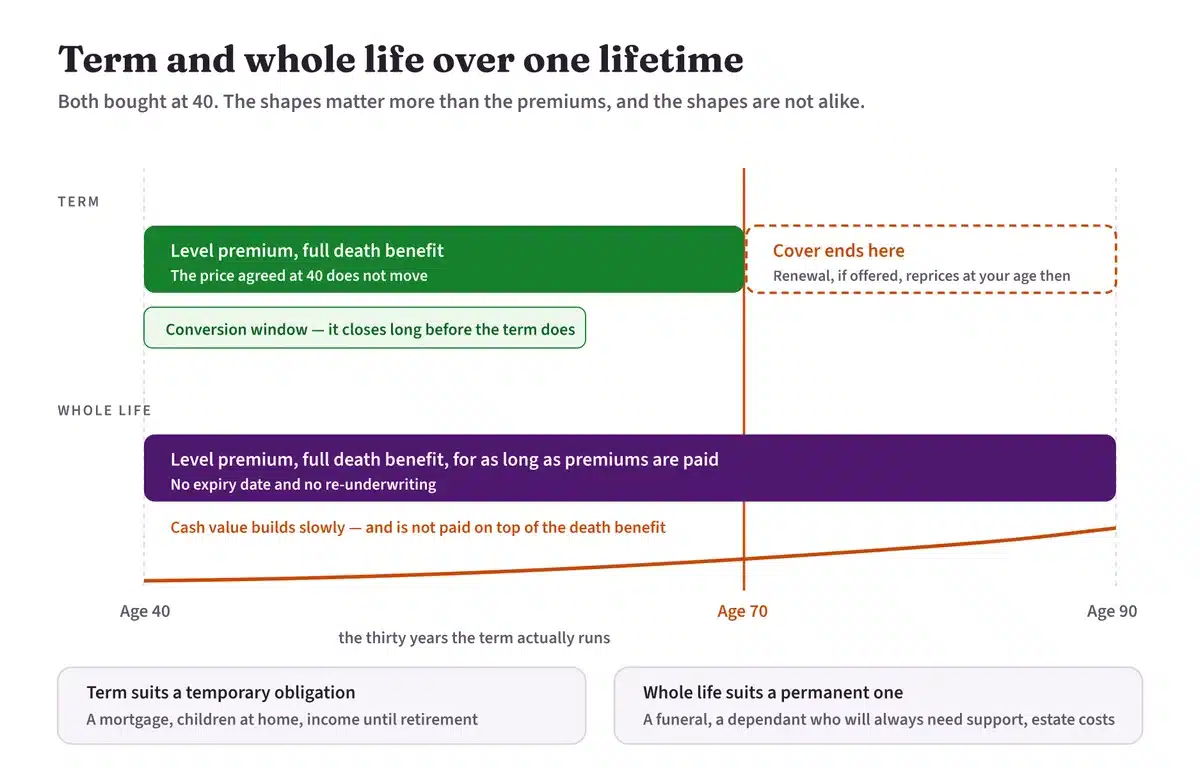
Term life insurance is the simplest product in the whole insurance market. You choose an amount and a number of years. If you die inside those years while the policy is in force, the insurer pays that amount to the people you named. If you outlive the term, nothing is paid and the cover ends.
That plainness is the point. Because there is no savings component, almost every dollar of premium buys death benefit, which is why term life insurance gives you far more cover per dollar than any permanent policy at the same age.
The death benefit is generally paid to your beneficiaries free of federal income tax, and it is paid regardless of what the money is then used for: a mortgage, tuition, replacing a salary, or simply keeping a household running while it adjusts.
Choosing a term length
The right term is the number of years your household would struggle without your income. Most people do not need cover for life. They need it until a specific obligation ends.
A 20-year term covers a young family through the years children are dependent. A 15-year term often matches the remaining balance of a mortgage. A 10-year term can bridge the gap between an early retirement and the point where a pension or Social Security starts.
Buy the term you actually need rather than the longest one available. A 30-year policy taken at 55 costs a great deal more than a 10-year policy, and the last decade of it may cover a period when nobody depends on your earnings.
What term life insurance costs, and what moves the price
Four things drive the premium, in roughly this order of impact.
Age. Term life insurance prices rise steeply with age, and the increase accelerates after 50. The single largest saving available to most applicants is applying sooner rather than later.
Health. Blood pressure, cholesterol, body mass, and any history of cancer, cardiac events or diabetes all move you between rate classes. The gap between the best and standard classes can be 40% or more of the premium.
Tobacco. Nicotine use in any form typically doubles the rate. Most carriers will re-rate you after a documented period without it, which is worth asking about rather than assuming.
Amount and term. These scale predictably. Doubling the death benefit roughly doubles the premium; adding years adds more than people expect.
What does not move the price is which agent sells it to you. Term life insurance rates are filed with each state’s insurance department, so an identical policy from the same carrier costs the same wherever you buy it.
Level term, decreasing term and return of premium
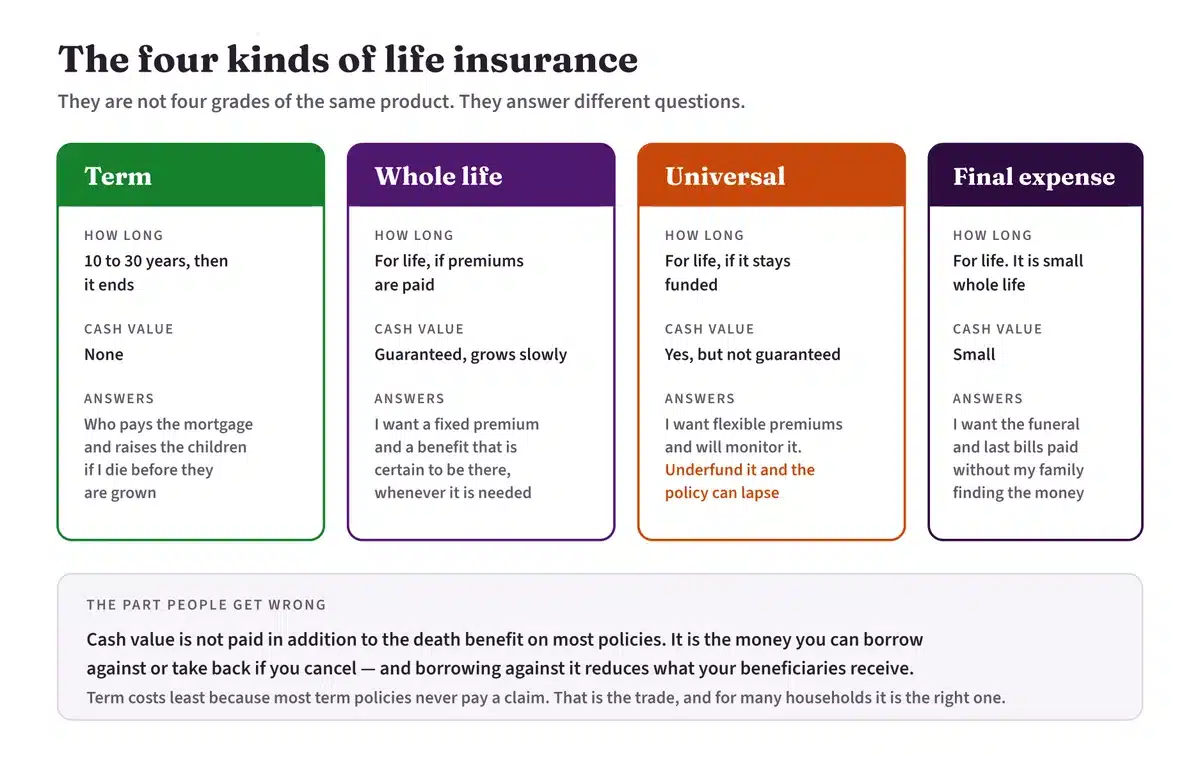
Level term is the standard: the premium and the death benefit both stay flat for the whole term. This is what most people mean by term life insurance and what we quote unless there is a reason not to.
Decreasing term reduces the death benefit over time, usually to track a mortgage balance. It is cheaper, but the saving is often smaller than expected and the flexibility is worse.
Return of premium policies refund your payments if you outlive the term. They cost substantially more, and the refund is not adjusted for inflation, so what comes back is worth less than what went in. They suit a narrow set of circumstances.
Conversion: the option most people forget to ask about
Many term life insurance policies include a conversion privilege, letting you exchange some or all of the cover for a permanent policy without answering new health questions.
That option is worth real money if your health changes. Someone diagnosed with a serious condition at May 58 be uninsurable on the open market but can still convert an existing term policy.
Conversion rights vary sharply between carriers: some allow it for the full term, others only for the first ten years or up to a certain age; some allow conversion into any permanent product, others into one designated policy. Ask for the specific terms in writing before you buy, not afterwards.
Term life insurance as you approach Medicare age
Most of the people we work with are at or near 65, and the questions change at that point.
If you still have a mortgage, a dependent spouse, or a business obligation, term life insurance may still be the right instrument, and short terms are readily available into the seventies with some carriers.
If your goal has narrowed to covering a funeral and final bills, term is usually the wrong tool. A final expense policy is designed for that, does not expire, and asks far fewer health questions.
And if a term policy you bought years ago is about to end, look at conversion before it lapses. Once the term expires the option goes with it.
Common mistakes with term life insurance
Relying only on employer cover. Group life typically ends when the job does, and it is rarely portable on good terms. It is a supplement, not a plan.
Naming an estate as beneficiary. Naming people directly keeps the payout out of probate. Naming your estate can delay it by months.
Never revisiting the beneficiary form. Divorce, remarriage and deaths in the family all change who should be listed, and the form governs, not your will.
Buying the amount that fits the budget rather than the need. Work out the need first. If it is unaffordable, shorten the term before you cut the death benefit.
How the application and underwriting actually run
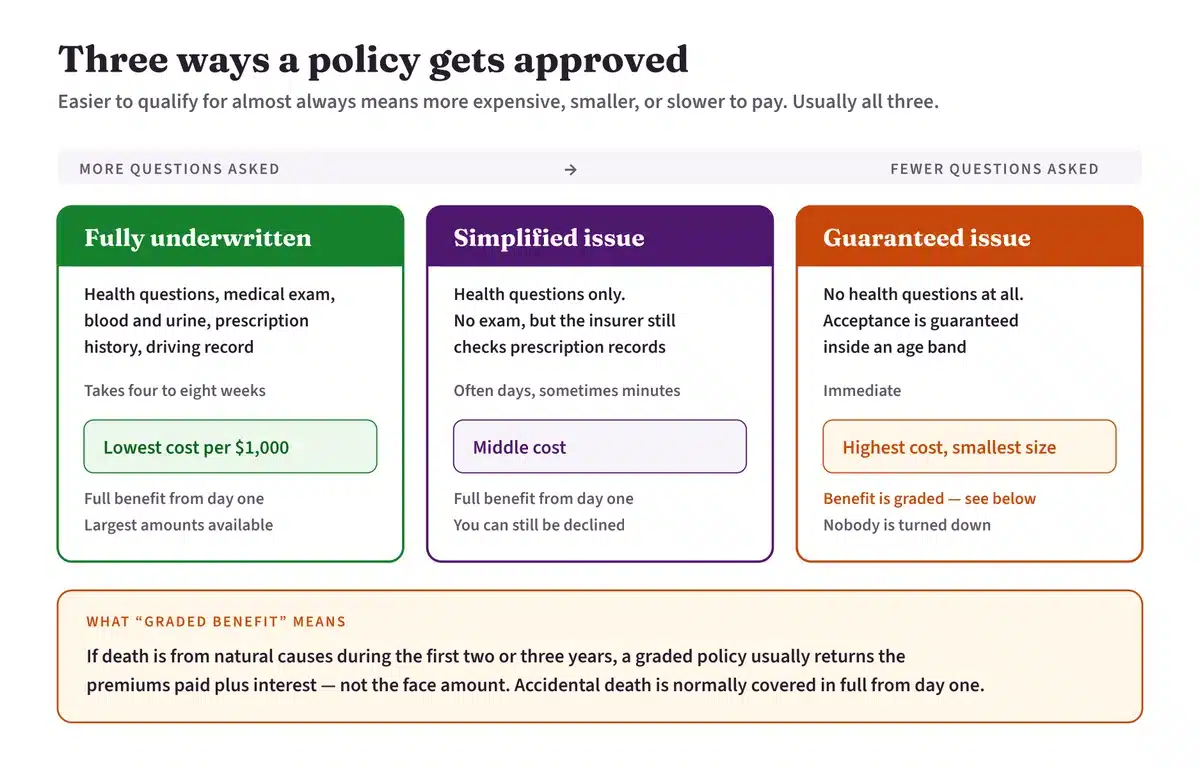
There are three routes to a term life insurance policy, and which one you take affects both the price and how long it takes.
Fully underwritten. A paramedical exam, blood and urine samples, and a review of your prescription and motor-vehicle records. It takes three to six weeks and produces the lowest rates for people in good health.
Accelerated underwriting. No exam for applicants who fit the carrier’s profile on age, amount and answers. Decisions can come in days. Rates are close to fully underwritten, sometimes identical.
Simplified issue. Health questions only, no exam and no records pulled. Fastest and most forgiving, but the death benefit is capped lower and the rate is higher.
Answer every question accurately. Term life insurance contracts carry a contestability period, normally the first two years, during which the insurer can review the application if a claim arises. A misstatement found then can reduce or void the benefit at the worst possible moment.
Questions we are asked most
Can I have more than one policy? Yes, and layering is often cheaper than one large policy, for example a 30-year policy for income replacement alongside a 15-year one that ends when the mortgage does.
What happens if I miss a payment? Policies carry a grace period, usually 30 or 31 days. After that the cover lapses, and reinstating it may require new health questions.
Does term life insurance pay for suicide? Most contracts exclude it during the first two years and pay normally afterwards. The exact wording is in the policy.
Will my premium ever change? Not during a level term, provided you pay on time. At the end of the term, most policies renew annually at a sharply higher rate, which is the point at which most people let them lapse.
Check any of this independently
None of this should be taken on our word alone.
- NAIC: life insurance consumer information, from the association of state insurance regulators
- NAIC consumer tools: look up any agent’s license and complaint history
- NAIC consumer resources, including how to trace a lost policy
Related guides on this site
- Life insurance overview: how term, whole, universal and final expense compare
- Whole life insurance and final expense cover
- Medicare Simplified, if you are also approaching 65
- Book a no-cost appointment
Or call (877) 808-2900. We will price term life insurance against your actual age, health and obligations, and tell you if you need less of it than you think.
Ask before you decide
Frequently asked questions about term life insurance
Does guidance cost me anything?
No additional fee is charged to you for O’Neal Insurance Group’s guidance. Agents may be compensated by an insurance carrier when an enrollment occurs.
Is every plan available through the agency?
No. The agency does not offer every plan available in every area. Availability depends on location, eligibility, carrier appointment, and product availability.
Official resource
Laddering: buying term life insurance in layers instead of one block
Most households do not need the same amount of cover for the same length of time. The mortgage runs twenty years, the youngest child is independent in fifteen, and income replacement matters until retirement. One policy sized for the largest of those and lasting as long as the longest is the expensive way to buy term life insurance.
Laddering means holding two or three policies of different lengths at once. As each obligation ends, a layer expires and the premium falls with it, without any need to re-apply or prove your health again.
A household might hold a long policy sized to income replacement until retirement, a medium one matched to the mortgage, and a short one covering the years until the youngest child finishes education. Total cover is highest in the early years, when the need is highest, and steps down on a schedule you chose rather than one an insurer imposed.
Two cautions. Several policies mean several policy fees, so at small face amounts the saving can disappear; ask for the comparison both ways. And each layer is separately underwritten unless bought together, so buy them at the same time while your health is what it is today.
Decreasing term is sometimes offered as an alternative, with the benefit falling automatically. It is simpler, and it is usually worse value, because the premium does not fall with it.
Rate classes, and what to do if yours comes back worse than quoted
The price quoted at the start of an application is an estimate of the class an insurer will offer. The class it actually offers is decided at the end, after the evidence is in, and the gap between them can be substantial.
Insurers use their own class names, but the structure is consistent: a top preferred class for the healthiest applicants, one or two intermediate classes, a standard class covering most people, and then substandard or table ratings for applicants with a specific risk. Tobacco use is priced as a separate track throughout, and definitions of what counts as tobacco vary between companies more than people expect.
Build, blood pressure, cholesterol ratios, family history, driving record and any history of treatment all feed the decision. So does what your prescriptions imply, which is why a medicine taken for an off-label reason is worth explaining on the application rather than leaving to be discovered.
If the offer is worse than expected, you have options and most people use none of them. Ask which specific finding drove the decision. Ask whether the insurer will reconsider on new evidence, such as a repeat reading taken under better conditions or a specialist letter putting a finding in context. Ask what the same application would look like at a different company, because underwriting guidelines are not uniform and one insurer’s table rating is another’s standard.
If a rating stands and your health later improves (weight lost and kept off, blood pressure controlled, several years since a treatment ended), many insurers will review the policy on request. That review is not automatic and nobody will prompt you. Diarise it.
The last years of a term life insurance policy
A level term policy does not simply stop on the final day in most cases. What usually happens is that it becomes annually renewable, at a premium recalculated for your age at that point, and it rises steeply every year thereafter until a stated age.
That renewal is a genuine safety net for someone in poor health who cannot buy new cover, and an expensive mistake for anyone who simply did not open the letter. Know which one you are.
Three real options exist as the level period closes. Let it end, if the obligation it was bought for has ended too. Convert some or all of it to permanent cover, which requires no medical evidence but must be done inside the conversion window, typically well before the term itself expires. Or apply for a new policy, which is the cheapest route if your health is good and impossible if it is not.
The decision belongs about two years before the level period ends, not two months. That is enough time to be underwritten, to convert, or to discover that conversion has already closed and plan around it.
Anyone approaching that point while also approaching Medicare age has a second reason to look early. Health tends to become less straightforward in the same years, and term life insurance is priced on health more than on anything else.
We will read the conversion provisions of an existing policy with you at no cost, whether or not it is one we sold, because the answer is in the contract rather than in the annual statement.
Check the source, then ask for personal help
Educational information is general. A licensed agent can help with plan comparisons; agents do not provide medical, legal, or official eligibility advice.
Personal guidance · No additional fee