
Utah Medicare guidance
Compare Medicare and Insurance Plans in Utah
O'Neal Insurance Group helps Utah residents compare Medicare and other insurance choices available at their permanent residence. Licensed agents explain costs, networks, prescriptions, and plan rules in plain language.
- Independent Medicare guidance
- Your own personal broker contact
- No-cost consultation
- Licensed agent support

Medicare plans Utah residents can join in 2026 fall into three groups: Original Medicare paired with a Medigap policy, Medicare Advantage, and standalone Part D prescription drug coverage. Which of the Medicare plans Utah carriers offer are open to you depends on the county of your permanent address, not the city you name.
Medicare Guidance Across Utah Communities
Utah's Wasatch Front contains most of the state's population, yet county service areas remain important from Salt Lake and Utah counties to Cache Valley, southwest Utah, and smaller mountain or desert communities. A plan seen in Salt Lake City may not serve St. George or Cedar City. The residential ZIP code and county must therefore lead every comparison.
Your Own Personal Medicare Agent Broker can keep the details organized. A Need Analysis records doctors, hospitals, pharmacies, prescriptions, expected care, budget, travel, and coverage priorities. A Scope of Appointment, when required, identifies the Medicare product categories you agree to discuss. Insurance agents use these steps to evaluate health coverage requirements and comply with federal Medicare marketing rules. Neither form commits you to enroll.
Along the Wasatch Front, residents may use providers across several neighboring counties. Elsewhere, travel time to a hospital or specialist may matter as much as copayments. Check each physician location, hospital, pharmacy, and drug before deciding. Review coverage annually because premiums, networks, formularies, authorization rules, and supplemental benefits can change.
Work with a Medicare Health Insurance licensed insurance agents broker serving Utah for a current county-and-ZIP comparison.
Medicare, Health, Life, and Dental Insurance Help in Major Utah Cities
- Salt Lake City — 218,428. Salt Lake County residents should check local hospital systems and whether preferred specialists participate.
- West Valley City — 137,491. West-side residents should compare pharmacy access and the network status of providers elsewhere in the valley.
- West Jordan — 116,812. Salt Lake County options may share a service area while still differing in networks and formularies.
- Provo — 114,527. Utah County residents should review Provo-area care together with specialists used in nearby cities.
- St. George — 108,713. Washington County residents should evaluate southwest Utah networks and rules for care while traveling.
- Lehi — 95,313. Fast-growing north Utah County residents should verify every clinic location and affiliated hospital.
- Orem — 95,214. Orem residents should include Utah Valley doctors, pharmacies, and recurring prescriptions in the comparison.
- Sandy — 92,386. Salt Lake County residents who receive care throughout the metro should check each provider address.
- Ogden — 89,510. Weber County comparisons should account for local hospitals and referrals along the northern Wasatch Front.
- South Jordan — 87,614. Residents should confirm network access in both the southwest valley and other frequently used areas.
Population source: U.S. Census Bureau Vintage 2025 incorporated-place estimates, July 1, 2025.
Medicare plans Utah: a review county by county
- Salt Lake County — 1,220,916: Salt Lake City, West Valley City, West Jordan, Sandy, and South Jordan residents should verify MA, SNP, network, drug, and supplemental-benefit availability.
- Utah County — 759,859: Provo, Lehi, Orem, Eagle Mountain, and Saratoga Springs residents should check current county offerings and medical groups.
- Davis County — 381,227: Layton, Bountiful, Syracuse, and Clearfield residents should compare northern metro networks and formularies.
- Weber County — 278,174: Ogden, Roy, and North Ogden residents should confirm service areas and hospital access.
- Washington County — 213,670: St. George, Washington, and Hurricane residents should check southwest Utah provider systems.
- Cache County — 145,000: Logan, North Logan, and Smithfield residents should review Cache Valley care and specialty travel.
- Tooele County — 87,461: Tooele, Grantsville, and Stansbury Park residents should verify local access and Salt Lake-area network use.
- Iron County — 67,141: Cedar City, Enoch, and Parowan residents should check rural networks, pharmacies, and referral routes.
- Box Elder County — 65,320: Brigham City, Tremonton, and Garland residents should confirm county choices and northern Utah providers.
- Summit County — 43,141: Park City, Kamas, and Coalville residents should examine local networks and care outside the county.
Population source: U.S. Census Bureau Vintage 2025 county estimates, July 1, 2025.
Understanding the Medicare plans Utah residents can choose
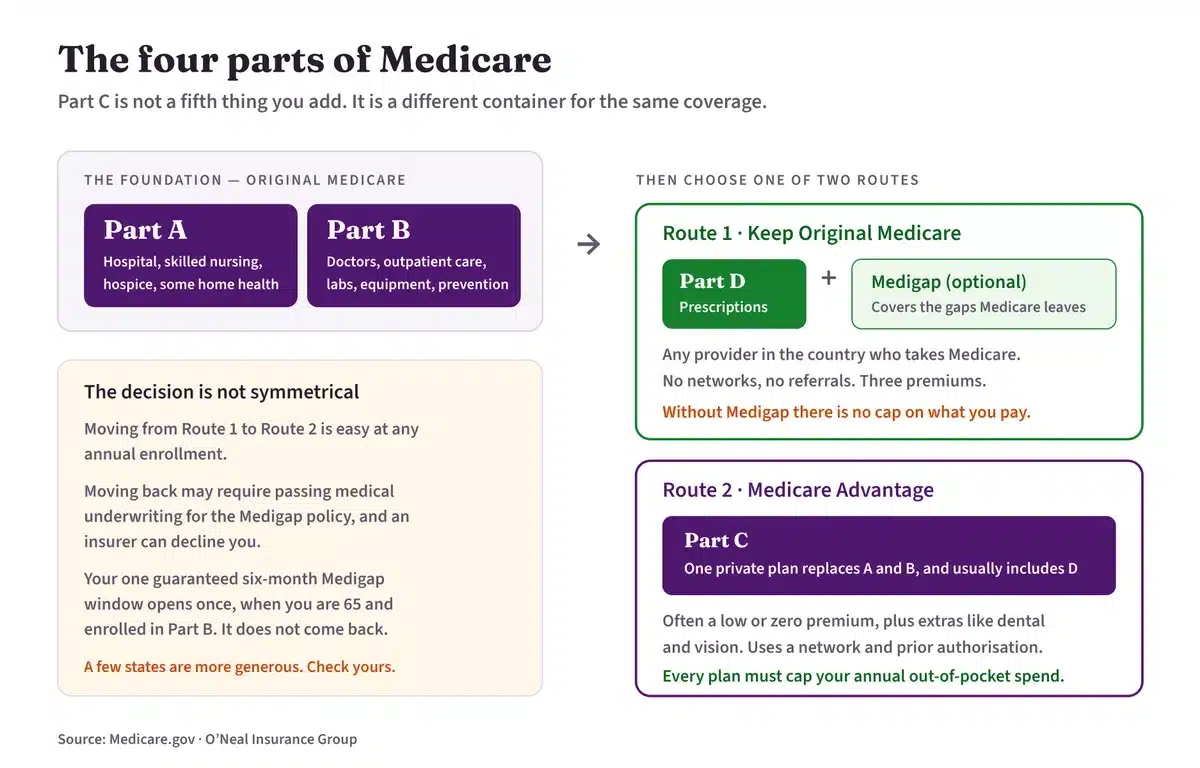
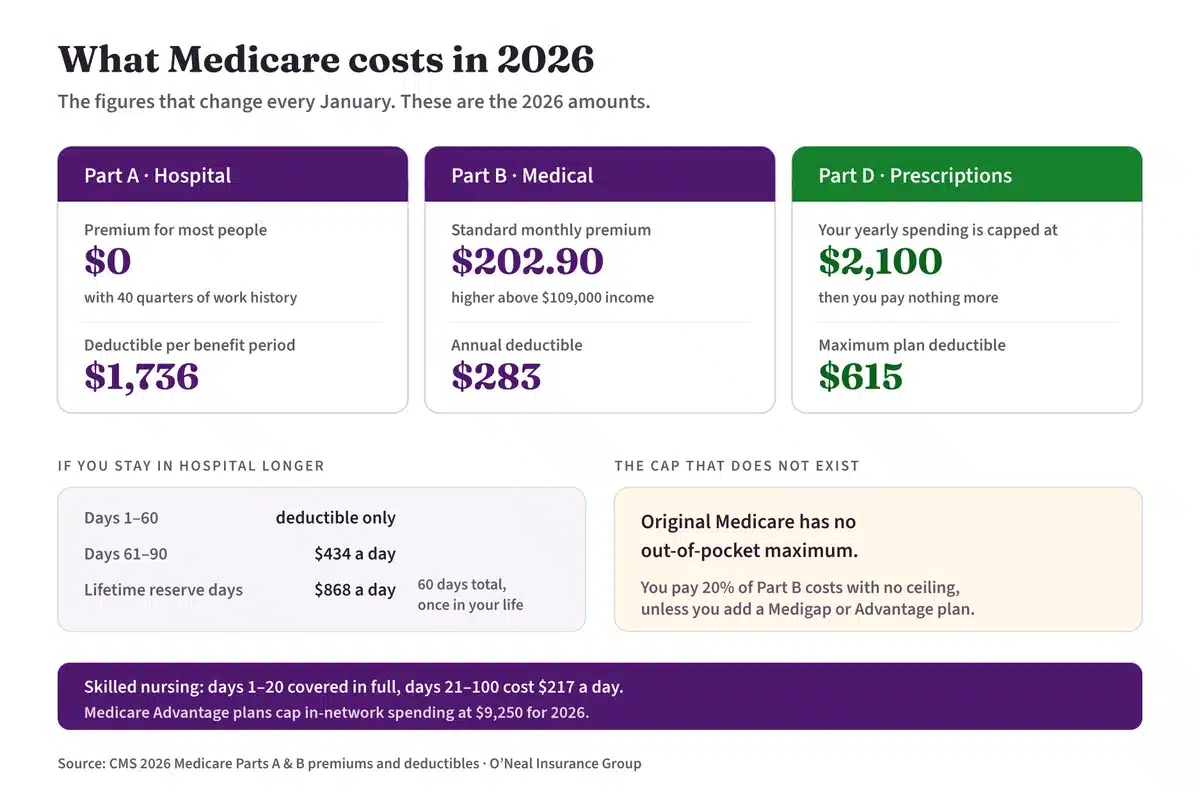
Original Medicare is federal coverage. Part A generally covers inpatient hospital care, skilled nursing facility care, hospice, and certain home health services. Part B generally covers physicians, outpatient care, preventive services, and durable medical equipment. Original Medicare does not have an annual Part A/B out-of-pocket maximum.
Medicare Advantage (Part C) is private Medicare-approved coverage that supplies Part A and B benefits; many plans include Part D. A stand-alone Part D plan can accompany Original Medicare. Medigap helps pay certain Original Medicare cost sharing and cannot be used with Medicare Advantage. Hospital indemnity and critical illness policies are separate limited-benefit insurance, not Medicare.
| Coverage option | How it works | Provider access | Prescription coverage | Possible additional benefits | Fitness membership | Flex card | Important considerations |
|---|---|---|---|---|---|---|---|
| Original Medicare | Federal Parts A/B | Medicare-participating providers | Add Part D | Medicare-covered services | No standard benefit | No | No annual A/B cost cap |
| Medicare Advantage | Private Part C | Network and county rules | Often included | May include dental, vision, hearing, OTC, transportation, or more | Plan-specific | Plan-specific | Check network, formulary, authorization, and MOOP |
| Medigap + Original Medicare | Supplements certain A/B costs | Original Medicare access | Separate Part D usually needed | Generally not MA-style extras | Policy-specific, if any | No standard benefit | Premium and enrollment rules apply |
| Stand-alone Part D | Prescription plan | Pharmacy network | Yes | Drug coverage only | No | No | Check formulary, tiers, and restrictions |
| Hospital indemnity / critical illness | Separate limited-benefit policy | Contract-specific | Not comprehensive drug coverage | Defined-event benefits | No | No | Not comprehensive health coverage |
Medicare Advantage HMO and PPO Options
HMOs generally use contracted networks and primary-care coordination; referrals may apply. PPOs generally allow more out-of-network flexibility at different costs, although noncontracted providers may decline routine care. Both can use formularies and prior authorization. Check doctors, hospitals, pharmacies, prescriptions, and service areas before enrolling. Every Medicare Advantage plan has a medical maximum out-of-pocket limit, but Part D spending is generally separate. Neither plan type is right for everyone.
Special Needs Plan Guidance
D-SNPs
Dual-Eligible Special Needs Plan eligibility depends on Medicare, the applicable level of Utah Medicaid, the plan service area, and other plan requirements. Medicaid category can affect coordination, benefits, and member costs.
C-SNPs
Chronic Condition Special Needs Plan enrollment requires a qualifying condition and confirmation that the plan serves the county. Diabetes, certain cardiovascular conditions, chronic heart failure, and other qualifying conditions are examples; offerings differ.
I-SNPs
Institutional Special Needs Plans may serve people who meet institutional or equivalent level-of-care requirements. Availability and facility participation must be verified locally.
Help for People With Medicare and Utah Medicaid
People with Medicare and Utah Medicaid are dual eligible. Utah describes QMB, SLMB, and QI as Medicare cost-sharing programs rather than full Medicaid programs. A person may have Medicaid and QMB or SLMB; Utah states that QI is for people not receiving Medicaid. Assistance varies by category and may address Medicare premiums or certain cost sharing. Verify the current category with Utah Medicaid or Social Security. Agents do not decide eligibility.
LIS and Extra Help Are the Same Program
The Low-Income Subsidy (LIS) and Extra Help are two names for one federal Part D assistance program. Eligible beneficiaries may receive help with Part D premiums, deductibles, and prescription cost sharing. Ask O'Neal Insurance Group for help understanding the application and plan-comparison process; Social Security or Medicare determines eligibility.
Medicare Guidance for Utah Veterans
VA health care and Medicare are separate systems, and Medicare Advantage does not replace VA benefits. Veterans should review VA prescriptions, non-VA providers, referrals, and emergency or urgent care procedures. TRICARE For Life generally coordinates with Medicare for eligible beneficiaries. Confirm decisions that could affect military benefits with the VA or TRICARE.
Part B Giveback and Flex Card Benefits
A Part B giveback is a plan-specific reduction in the amount a beneficiary pays toward the Medicare Part B premium. It is not a cash payment and is not offered by every plan. A flex card is also plan-specific; eligible expenses, allowances, participating retailers, and usage rules differ.
Part B premium reductions, flex cards, and other supplemental benefits are not included with every Medicare Advantage plan. Availability, eligibility, benefit amounts, approved expenses, and participating locations vary by plan and service area.
Dental, vision, hearing, transportation, fitness, OTC, food, utility, and similar benefits may have eligibility, network, frequency, or usage restrictions.
Which carriers sell Medicare plans Utah residents can join
The CMS July 2026 landscape shows offerings in one or more Utah counties under Aetna Medicare, Devoted Health, HealthSpring, Humana, Molina Healthcare of Utah & Idaho, Select Health, UnitedHealthcare, and Wellcare. Product types differ, and Wellcare evidence may relate to Part D rather than Medicare Advantage. This does not establish statewide availability or an O'Neal appointment.
Carrier and product availability varies by state, county, ZIP code, eligibility, and plan year. Contact O'Neal Insurance Group to learn which companies and plans are currently available in your area.
Additional Insurance Coverage
- Individual and family health: Major medical coverage for people who are not relying on Medicare.
- Life and final expense: Life insurance pays according to the contract after death; final expense policies are often compared for funeral and related costs.
- Dental and vision: Separate specified-service insurance, not Part of Original Medicare.
- Critical illness and cancer, heart attack, or stroke: Limited-benefit policies for contract-defined diagnoses.
- Hospital indemnity: Defined benefits for covered hospital events; it is not comprehensive medical coverage.
- Accident: When available, limited benefits for covered accidental injuries.
How a licensed agent narrows the Medicare plans Utah offers
An agent can review Medicare eligibility and enrollment periods; compare premiums and expected out-of-pocket costs; check doctors, hospitals, pharmacies, networks, and formularies; explain routes for Extra Help, Utah Medicaid, or MSP assistance; compare HMO, PPO, D-SNP, and C-SNP choices; explain plan-specific benefits; help submit an enrollment application after the consumer decides; and review non-Medicare coverage. Government agencies determine program eligibility.
How to compare the Medicare plans Utah sells, in seven steps
- Confirm Medicare eligibility and enrollment period.
- Confirm Utah Medicaid status or ask Utah HHS about applying.
- Enter the permanent residential ZIP code and county for an online instant quote or comparison.
- List doctors, hospitals, pharmacies, all prescriptions, Medicaid or Extra Help status, and veteran or VA use.
- Review premiums, deductibles, copayments, coinsurance, networks, formularies, and maximum out-of-pocket limits.
- Check eligibility requirements and plan-specific benefits.
- Select a plan and submit an enrollment request only after reviewing official plan documents.
Frequently Asked Questions
What Medicare Advantage plans are available in Utah?
Choices differ by county, ZIP code, eligibility, and plan year. A current residential-address search is required.
Does Medicare Advantage availability vary by Utah county?
Yes. Neighboring metro, suburban, border, and rural counties can have different offerings and networks.
Can I keep VA health care and enroll in Medicare?
Many veterans use both, but they remain separate systems. Confirm VA-related decisions with the VA.
Who may qualify for a D-SNP in Utah?
A person must meet Medicare, applicable Utah Medicaid, county, and plan requirements.
What conditions may qualify someone for a C-SNP?
Examples can include diabetes, certain cardiovascular conditions, and chronic heart failure, subject to plan verification.
Is Extra Help the same as LIS?
Yes. Both names refer to the same federal Part D assistance program.
How does a Part B giveback work?
It reduces the amount paid toward the Part B premium according to plan rules; it is not a cash payment.
Does every Medicare Advantage plan include a flex card?
No. Availability, eligible expenses, allowances, retailers, and rules vary.
What is the difference between an HMO and a PPO?
HMOs generally use more structured networks; PPOs generally allow more out-of-network flexibility at different costs.
Can an insurance agent help me enroll?
Yes, after you decide. Medicare and the carrier make the final enrollment determination.
Is there a cost to speak with an O'Neal Insurance Group agent?
The agency offers a no-cost consultation with a licensed insurance agent.
What should I have ready before comparing plans?
Bring Medicare details, Utah ZIP and county, providers, prescriptions, pharmacies, current coverage, assistance notices, and VA or TRICARE information.
Need help comparing the Medicare plans Utah offers?
Call (877) 808-2900 or contact O'Neal Insurance Group online. A licensed agent can review available options based on ZIP code, county, eligibility, prescriptions, doctors, and coverage priorities.
Required Disclosures
Not all carriers, products, benefits, or plans represented by O'Neal Insurance Group are available in every state, county, ZIP code, or service area. Plan availability and benefits may change each plan year. Please call or contact us to learn more about the options currently available in your area.
O'Neal Insurance Group is not connected with or endorsed by the United States government, the federal Medicare program, or any state Medicaid program.
“We do not offer every plan available in your area. Currently we represent 30 organizations which offer over 125 products in your area. Please contact Medicare.gov, 1-800-MEDICARE, or your local State Health Insurance Assistance Program (SHIP) to get information on all of your options.”
One caution before you begin. The Medicare plans Utah carriers advertise on television are not necessarily the Medicare plans Utah residents in your county can actually buy, because service areas are drawn county by county. Check availability against your own ZIP code before you settle on a benefit you have seen advertised.
Choosing between the Medicare plans Utah offers
Three questions settle most of it, and they are best asked in this order.
Your doctors first. Check every physician you want to keep against the plan directory, and confirm the medical group as well as the individual name. This alone eliminates most of the Medicare plans Utah carriers sell, usually within a few minutes.
Then your prescriptions. Two plans with an identical premium can differ by thousands of dollars a year once your real drug list is priced against each formulary. Among the Medicare plans Utah residents are offered, this is the step most often skipped and most often regretted.
Then how you prefer to pay. Medicare Advantage keeps the monthly cost low and charges you as you use care. Medigap reverses that: a higher predictable premium, very little at the point of service. Neither is better in the abstract; it depends on your cash flow and your tolerance for an unexpected bill.
Commissions are set by the Centers for Medicare & Medicaid Services and are identical across carriers for the same product line. An independent broker comparing the Medicare plans Utah carriers file therefore has no financial reason to steer you toward one of them.
What 2026 changes for the Medicare plans Utah residents hold
No Part D plan may charge a deductible above $615 this year. Once you have spent $2,100 out of pocket on covered drugs, your cost for the rest of the calendar year drops to zero, and the Medicare Prescription Payment Plan lets you spread that amount across monthly installments instead of facing it in January.
Those rules apply to every Part D policy, standalone or bundled inside an Advantage plan, so they change the arithmetic on all of the Medicare plans Utah carriers sell.
Networks, formularies and copays still move each January. The Annual Notice of Change your carrier sends by September 30 is where those changes are disclosed, and it is the document worth reading before Annual Enrollment closes on December 7.
Enrollment windows that apply to the Medicare plans Utah sells
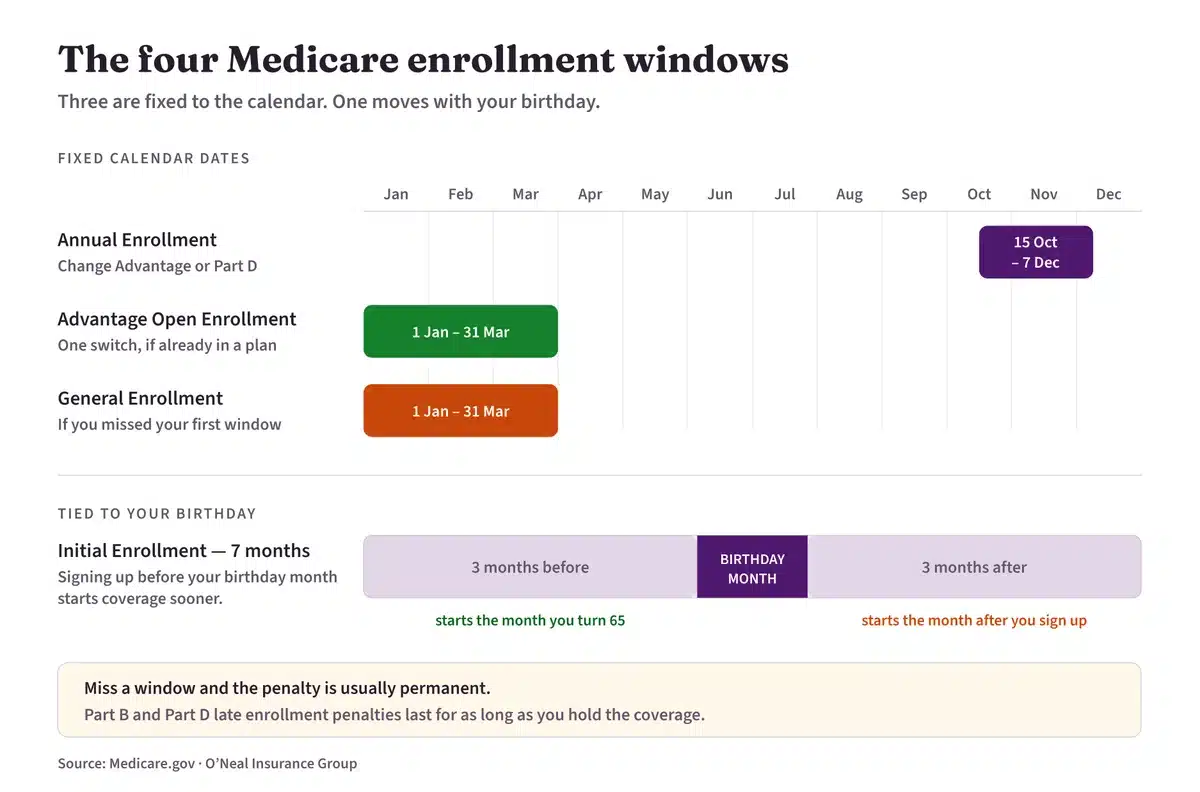
Initial Enrollment Period. Seven months centred on the month you turn 65 — the three months before, the birthday month, and the three months after. Part B and Part D late penalties are permanent, so this is the window that costs money to miss.
Annual Enrollment, October 15 to December 7. Open to everyone on Medicare. You may switch between Original Medicare and Medicare Advantage, change Advantage plans, or change Part D plans, and the change takes effect on January 1.
Medicare Advantage Open Enrollment, January 1 to March 31. One change only, and only for people already enrolled in an Advantage plan.
Special Enrollment Periods. Moving out of a plan’s service area, losing employer coverage, entering or leaving a nursing home, or qualifying for Medicaid or Extra Help each open a window outside the normal calendar.
Medicare reference charts
The charts below cover the ground most questions start from.
Check the Medicare plans Utah offers independently
Before you commit to one of the Medicare plans Utah carriers offer, get a second opinion from an organization with no commission at stake. Each of these is free to use.
- Medicare.gov Plan Compare — every plan sold in your ZIP code, with your prescriptions priced in
- SHIP National Technical Assistance Center — free one-to-one Medicare counseling in Utah, from counselors who sell nothing
- Social Security Administration — Extra Help with prescription drug costs
- National Association of Insurance Commissioners — look up any agent’s license and complaint history
Related guides on this site
- Medicare Simplified — the full guide for anyone new to Medicare
- What Medicare Advantage costs and how Medigap works
- The five Medicare deadlines that matter
- Meet James O’Neal and book a no-cost appointment
Or simply call (877) 808-2900 and we will go through the Medicare plans Utah residents qualify for, one at a time. There is no cost and no obligation, and if the best answer among the Medicare plans Utah offers is a plan we do not sell, we will tell you so.
Information reviewed August 1, 2026.