
Insurance Carriers
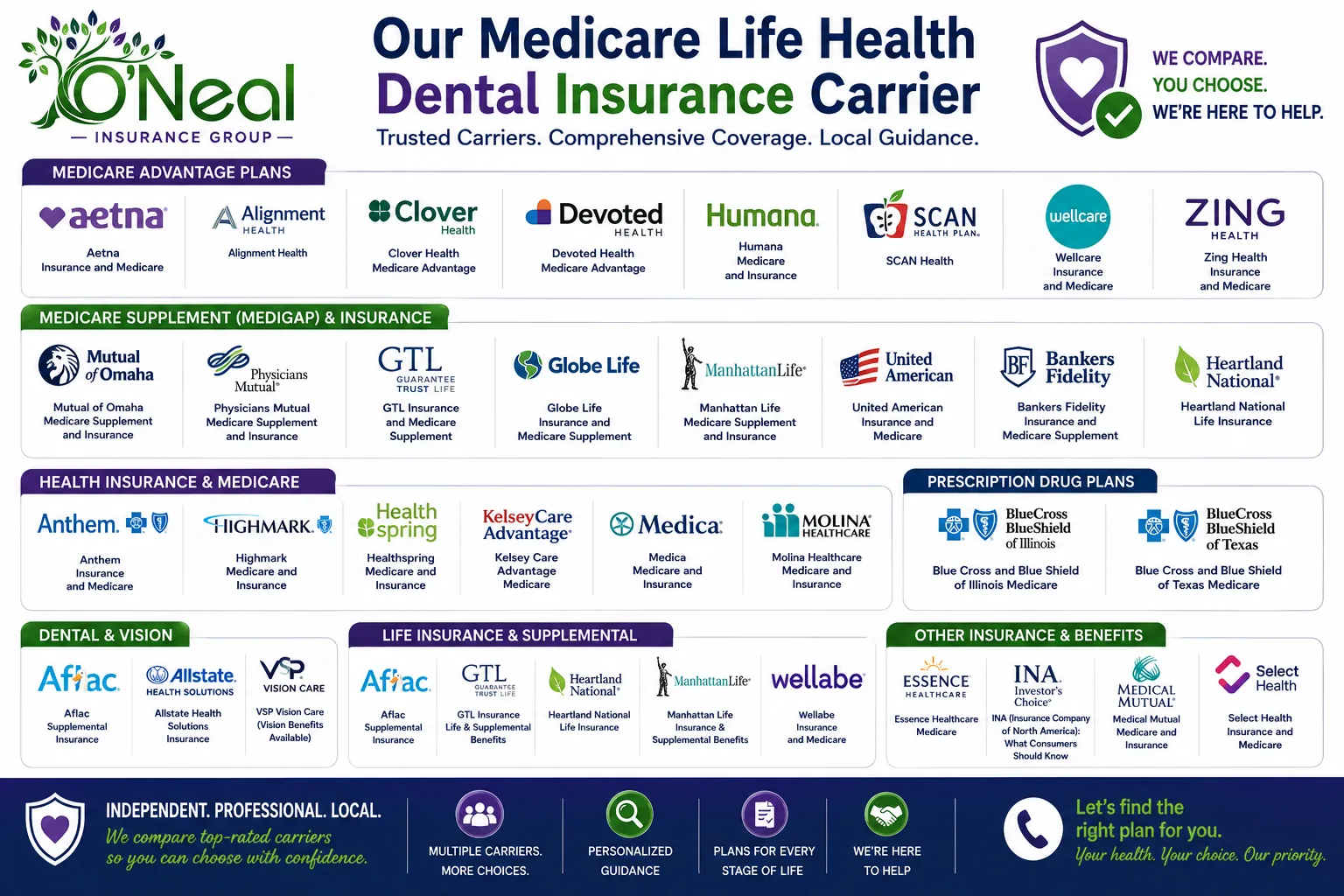
O’Neal Insurance Group helps Medicare beneficiaries, families, veterans, caregivers, and individuals compare insurance companies and coverage options available in their area. Carrier participation, plan types, provider networks, prescriptions, costs, and supplemental benefits can vary by state, county, ZIP code, eligibility, and plan year.
Use this directory to learn about the insurance organizations and product categories our licensed agents may Help you review. A carrier name does not mean every product is available where you live or that every applicant qualifies. Call (877) 808-2900 or request a no-cost consultation for current information based on your location and needs.
Insurance carriers we represent
- Aetna Insurance and Medicare
- Aflac Supplemental Insurance
- Allstate Health Solutions Insurance
- Anthem Insurance and Medicare
- Alignment Health
- Blue Cross and Blue Shield of Illinois Medicare
- Blue Cross and Blue Shield of Texas Medicare
- Bankers Fidelity Insurance and Medicare Supplement
- Clover Health Medicare Advantage
- Devoted Health Medicare Advantage
- Essence Healthcare Medicare
- Globe Life Insurance and Medicare Supplement
- GTL Insurance and Medicare Supplement
- HealthSpring Medicare and Insurance
- Humana Medicare and Insurance
- Heartland National Life Insurance
- Highmark Medicare and Insurance
- KelseyCare Advantage Medicare
- Medica Medicare and Insurance
- Molina Healthcare Medicare and Insurance
- Insurance Company of North America (INA): What Consumers Should Know
- ManhattanLife Medicare Supplement and Insurance
- Medical Mutual Medicare and Insurance
- Mutual of Omaha Medicare Supplement and Insurance
- Physicians Mutual Medicare Supplement and Insurance
- Select Health Insurance and Medicare
- SCAN Health
- United American Insurance and Medicare
- UnitedHealthcare and AARP Medicare
- Wellcare Insurance and Medicare
- Wellabe Insurance and Medicare
- Zing Health Insurance and Medicare
What it means when we say we represent insurance carriers
An independent agency is appointed by insurance carriers, one contract at a time. Appointment means the carrier has authorized us to explain and sell its products in a given state. It does not mean we work for that company, and it does not mean every product it makes is available where you live.
We currently represent 30 organizations which offer over 125 products. That is a large panel by any standard, and it is still not every insurer in the market. Nobody represents all of them, and any agency claiming otherwise is worth a second look.
What matters for you is narrower than the size of the list: which of these insurance carriers file plans in your county, which of those contract with your doctors, and which one prices your particular prescriptions best. Three questions, and the directory above is only the starting point for answering them.
National insurance carriers and regional ones
The directory mixes two quite different kinds of company, and the distinction is worth knowing.
National carriers operate in most states and offer a broad range of products. They tend to have the largest provider networks, the most predictable service processes, and the widest pharmacy arrangements. They also tend to be less flexible when something unusual happens.
Regional carriers operate in a handful of states or sometimes a handful of counties. Where they exist, they are frequently the best-priced option in their area, and their networks are built around local hospital systems rather than assembled nationally. The trade is portability: a regional plan that is excellent at home may be poor if you spend three months a year somewhere else.
Neither type wins in general. Which of the insurance carriers suits you depends on where you live, where you travel, and which hospital you would choose in an emergency.
How to judge insurance carriers, beyond the brochure
Four checks, all of which you can run yourself before you speak to anybody.
Financial strength. Independent agencies such as AM Best rate insurers on their ability to pay claims. This matters most for long-horizon products — life insurance and Medicare Supplement policies you expect to hold for decades.
Complaint records. The National Association of Insurance Commissioners publishes complaint data by company, and your own state insurance department publishes its own. A company with a complaint index well above its market share is telling you something.
Rate-increase history. Especially for Medicare Supplement policies, where benefits are fixed by law and the only variable is price over time. Past increases are not a promise about the future, but a carrier that has raised rates sharply every year is a different proposition from one that has not. State insurance departments publish filed increases.
Star ratings. Medicare publishes a one-to-five rating each year for Medicare Advantage and Part D plans, covering preventive care, member complaints, customer service and appeals handling. It is a good tiebreaker between two similar plans and a poor substitute for checking your own doctors.
Why a carrier name does not mean a plan is available
This causes more confusion than anything else on the page.
Medicare Advantage and Part D plans are approved county by county, not statewide. A carrier can be a household name nationally and file no plan at all in your county. It can file a plan in your county and a different plan in the next one, with a different network and different drug tiers under a similar name.
Availability also depends on eligibility. Some plans are built only for people who also have Medicaid, some only for people with a specific chronic condition, and some only for people in a defined institutional setting. A carrier listing tells you the company exists; it tells you nothing about whether you can enroll.
Plan year matters too. Insurance carriers add, withdraw and redesign plans annually, and a plan that was ideal last year can be gone or materially changed on January 1.
How we are paid by insurance carriers, and what that changes
We are paid a commission by the insurer when someone enrolls. For Medicare products the rates are set by federal rules rather than by carriers bidding against each other for a recommendation, which is the single most useful fact about how this market works.
Your premium is identical whether you enroll through us, through the carrier’s own phone line, or by yourself at Medicare.gov. There is no broker fee and no version of the plan that costs less because you did it alone.
What that leaves is a straightforward test you can apply to any agency: ask which insurance carriers they represent, and ask which ones they do not. An honest answer to the second question is worth more than a long list in answer to the first.
Questions we are asked about insurance carriers
Is a bigger carrier safer? For claims-paying ability, size correlates with stability but rating agencies measure it directly — check the rating rather than the brand.
Does the carrier or the plan matter more? The plan, almost always. Two plans from the same insurer in the same county can have different networks, different formularies and different costs.
Can I switch carriers later? For Medicare Advantage and Part D, yes, during the Annual Enrollment Period each autumn. For Medicare Supplement it depends on your state and your health, because outside your initial six-month window an insurer may ask health questions.
What if my carrier leaves my county? You get a Special Enrollment Period to choose something else, and you will be notified in writing before the plan year ends. It is not an emergency, but it is not something to ignore either.
Medicare reference charts
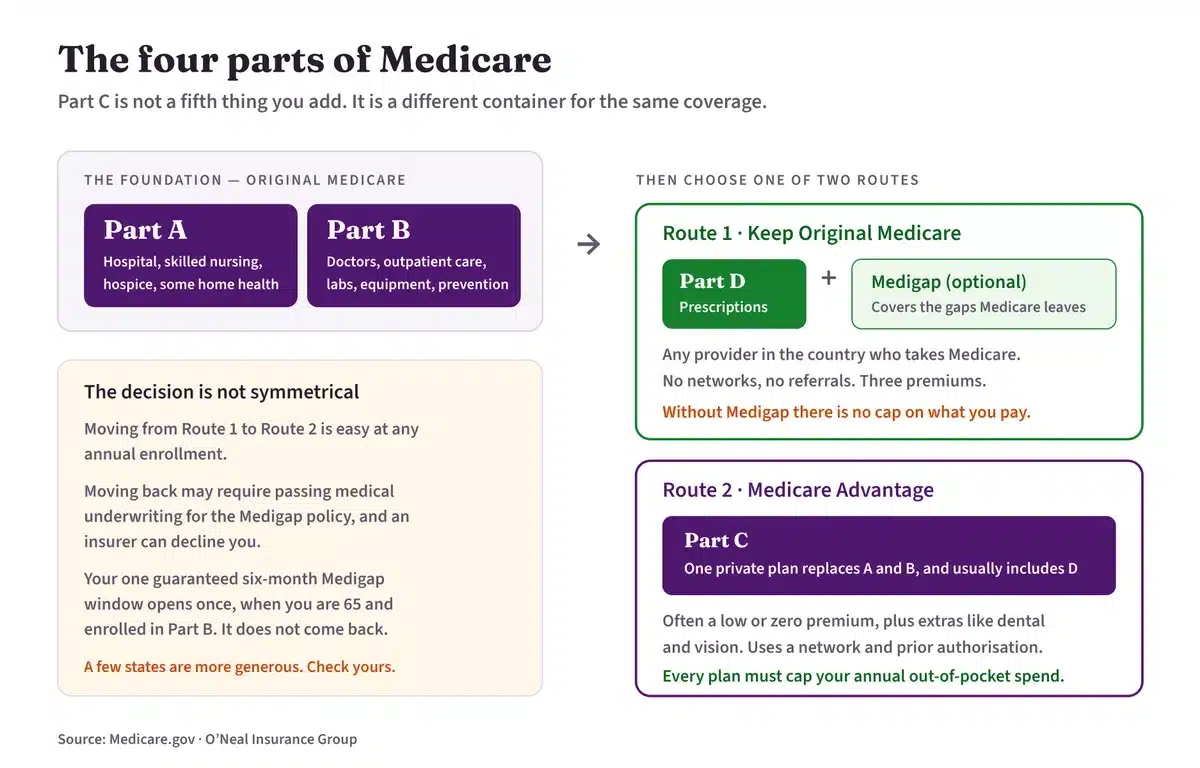
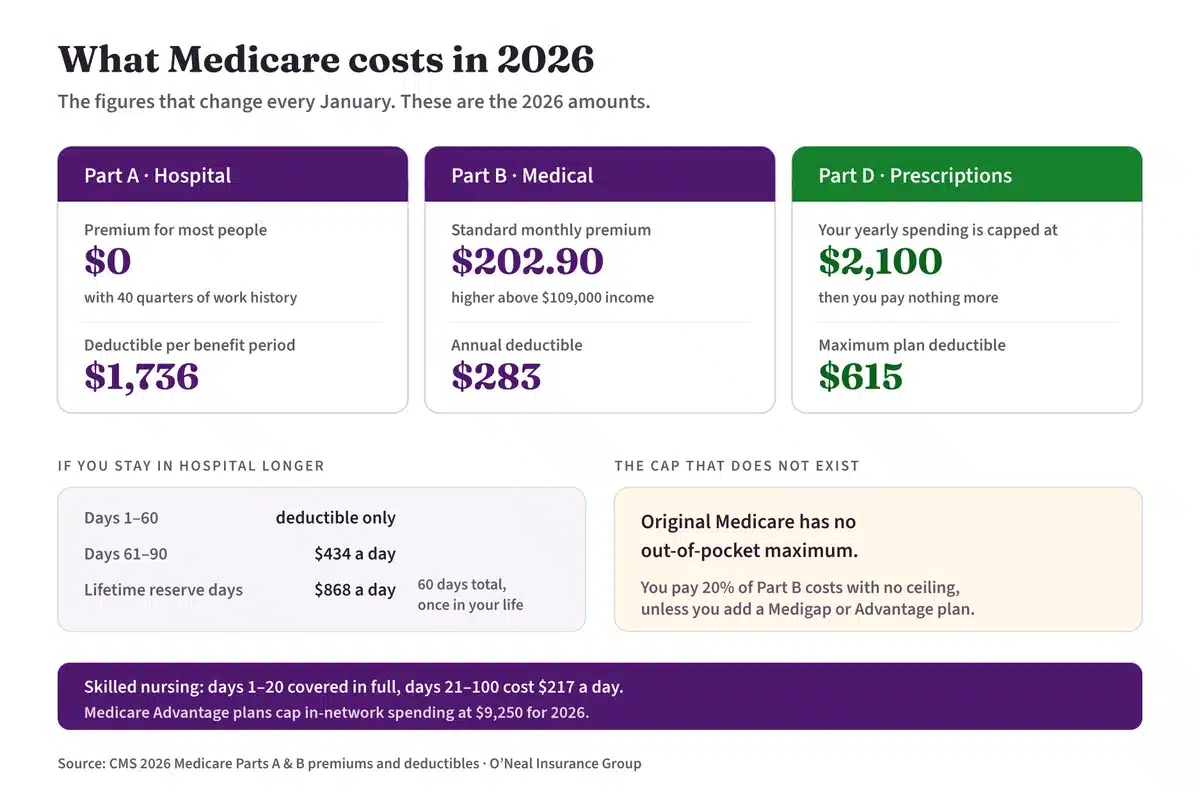
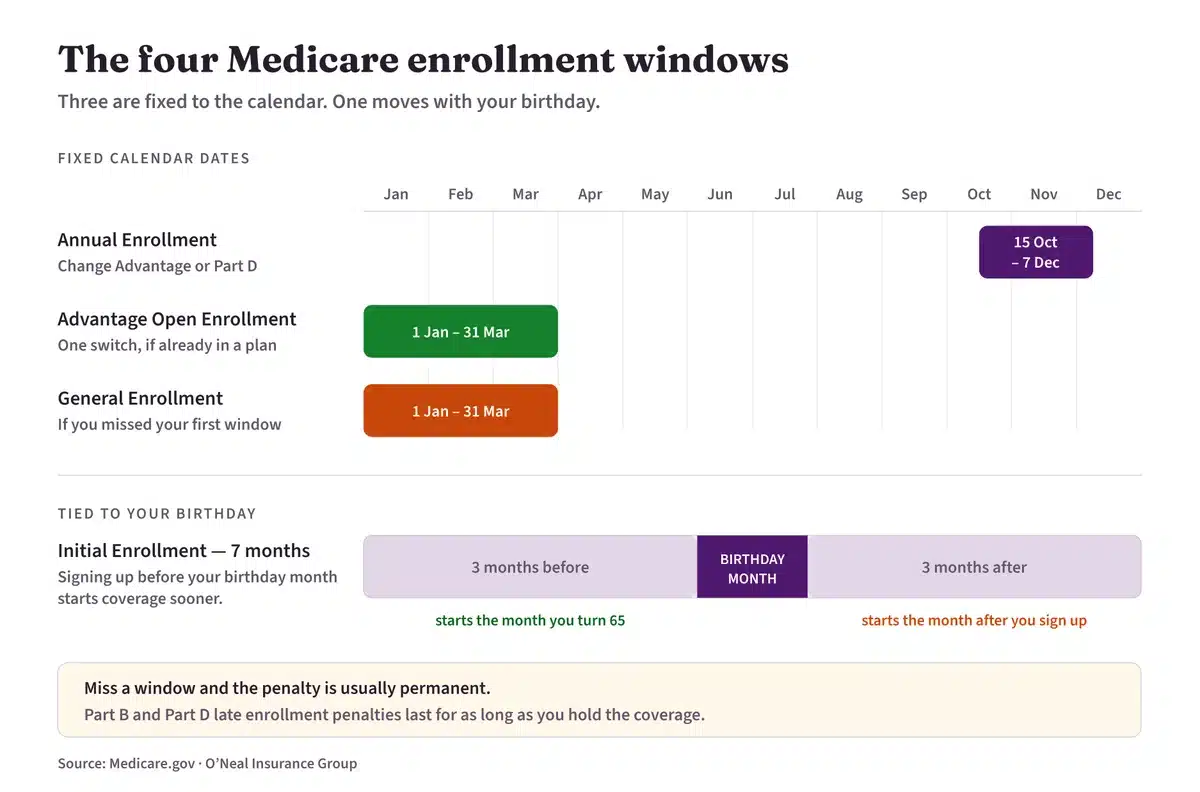
The charts below cover the ground most questions start from.
Judging carriers on things you can actually look up
Brochures are written by marketing departments. Three things about insurance carriers are published independently, and between them they tell you more than any brochure will.
Star ratings, and what they do not measure
CMS rates every Medicare Advantage and Part D plan from one to five stars each autumn. The score blends clinical quality measures, member experience surveys, complaint and disenrolment rates, and how the plan handles appeals and customer service.
It is a real signal and a blunt one. A rating covers a whole contract, which may span several plans and several states, so it says less about your particular network than the number implies. Read it next to the network check rather than instead of it.
There is a practical use for it beyond comparison. If a five-star plan is available where you live, you may switch into it once between December 8 and November 30, outside the Annual Enrollment Period. Few people know that window exists.
Financial strength ratings
Independent agencies — AM Best chief among them for insurance carriers, alongside S&P and Moody’s — publish an assessment of an insurer’s ability to pay claims. It matters most on products you intend to hold for decades, which means Medicare Supplement and life insurance rather than a plan you can change every autumn.
A strong rating is not a guarantee and a weaker one is not a disqualification. It is context, and it is free to check.
Rate history, which nobody advertises
On a Medicare Supplement policy the opening premium is the least interesting number. What matters is what the insurer has done to that premium over the past five and ten years, because you are buying a relationship you may hold for twenty.
An insurer can open low to win business and raise steeply afterwards. Ask for the rate increase history by policy form and by state before you buy, and ask us for it if a carrier will not give it. Several state insurance departments publish annual Medigap premium comparison guides that make the same point from the outside.
Why a carrier can appear here and still be unavailable to you
Two separate things have to be true before we can offer you a particular plan, and they fail independently.
First, the carrier has to have filed that plan in your county. Medicare Advantage and Part D service areas are defined county by county, so a plan advertised on national television may simply not exist where you live.
Second, we have to hold a current appointment with that carrier — a contract permitting us to sell its products — and an agent has to have passed that carrier’s certification for the current plan year. Appointments are added and dropped over time, by us and by the insurance carriers themselves.
So the list on this page is a statement about relationships, not a menu. When something worth considering sits outside it, we will tell you the plan exists and point you to Medicare.gov or 1-800-MEDICARE, because you are entitled to the whole picture rather than our slice of it.
Currently we represent 30 organizations offering over 125 products. That number moves as insurance carriers enter and leave markets, and it is worth asking for a current figure rather than trusting a page you read last year.
One last caution about brand names. Several of the largest insurance carriers operate under different corporate entities in different states, and a plan sold under a familiar name in one market may be administered by an entirely separate company in another. The name on the advertisement is not always the name on the contract, so check which entity actually issues the policy you are being offered.
None of this takes long. Bring the plan you already hold, the doctors you want to keep and your medication list, and the field of insurance carriers narrows to a handful in a single sitting. Where the honest answer is that your current carrier is still the right one, that is what we will tell you, and it costs you nothing to hear it.
If you would rather check the whole market yourself first, Medicare.gov lists every plan available in your county, including those from insurance carriers we do not represent. We would rather you arrived having looked.
What happens when a carrier leaves your county
It happens every year somewhere. A plan is not renewed, or an insurer withdraws from a market entirely, and members have to move.
If that affects you, the plan must write to you before the Annual Enrollment Period, and the letter is not junk mail. A non-renewal opens a Special Enrollment Period that runs into February, which is longer than the ordinary window and easy to waste by doing nothing.
It also carries something more valuable. A plan termination is one of the circumstances that triggers a guaranteed-issue right to buy certain Medicare Supplement policies without medical underwriting. That right is time-limited and it does not come round again, so it is worth acting on rather than defaulting into whichever plan you are automatically moved to.
Do nothing at all and you generally return to Original Medicare without drug coverage, which exposes you to a Part D late-enrollment penalty on top of everything else.
This is the clearest argument for keeping a relationship with an agency rather than enrolling once and forgetting it. We watch which insurance carriers are filing and withdrawing in the counties we serve, and a letter like that is the moment to ring us.
Check any of this independently
You do not need an agent to research an insurer.
- NAIC consumer tools — complaint records by company and agent license lookup
- Medicare Plan Finder — which carriers actually file plans in your ZIP code, with star ratings
- SHIP National Technical Assistance Center — free counseling from people who sell nothing
- AM Best — financial strength ratings
Related guides on this site
- Compare Medicare plans and enroll yourself
- Medicare Advantage plans — how the bundled route works
- Medicare Supplement (Medigap) — where carrier choice matters most
- How we help — and how we are paid
- Book a no-cost appointment
Or call (877) 808-2900. Tell us your county and we will say which of these insurance carriers actually file plans where you live before anything else is discussed.
Important availability information
Not all carriers, products, benefits, or plans represented by O’Neal Insurance Group are available in every state, county, ZIP code, or service area. Plan availability and benefits may change each plan year. Please call or contact us to learn more about the options currently available in your area.
O’Neal Insurance Group is not connected with or endorsed by the United States government, the federal Medicare program, any state Medicaid program, the Department of Veterans Affairs, or any insurance carrier.
We do not offer every plan available in your area. Currently, we represent 30 organizations which offer over 125 products in your area. Please get in touch with Medicare.gov or 1-800-MEDICARE to get information on all of your options.
Work With an Alabama Medicare Broker to Compare Your Plan Options. Call Today!Compare Medicare Health Insurance Plans in Arizona. Call a Licensed Agent TodayCompare Medicare Insurance Plans in California. Call a Licensed Agent TodayCompare Medicare and Insurance Plans in FloridaCompare Medicare and Insurance Plans in Georgia